


That stands for build your English fluency, increase your knowledge of the culture of English-speaking people, grow your vocabulary, and become a better and clearer English communicator.
So, if those are some of your goals, then you’re in the right place and I will do my best to help you achieve those goals. That’s what I’m here to do and yeah, your success makes me happy.
So, I’m gonna work hard to try and help you achieve those goals. For each and every bonus episode, there is a 100% free interactive transcript and vocabulary glossary, which you can get just by following the link in the description for this episode.
And if you are a Culips member, then we’ll also include a comprehension quiz. So yeah, get those tools. I think they’re very helpful in my personal opinion.
Of course, I am biased, but many people have told me that they are awesome learning tools, and you can get them for free just by clicking the link in the description for this episode.
So, in today’s story, guys, I’m gonna tell you about crossing an item off of one of my bucket lists. Yeah, it always feels good when you get to do that. Do you have a bucket list?
Do you have, like, a list of the goals and things that you want to achieve in life? Probably many people out there listening do and so that’s what I’m gonna share with you in this episode.
And I’ll get started with my story in just a moment. But first, I want to tell you about Culips membership.
If you’re ready to take your English to the next level, then I highly recommend signing up and becoming a Culips member.
When you’re a Culips member, you will get access to our learning materials that our expert team of English teachers have created to help you become a more fluent, a clearer, and a more confident English communicator.
So, this includes things like our interactive transcripts and helpful study guides for all of our episodes. In the study guides, you’ll have detailed examples and explanations of the key vocabulary and idiomatic expressions that we think you need to know to improve your fluency and to sound more natural with your English speaking.
There’s also comprehension quizzes in there and questions that you can use for speaking practice and writing practice. The guides are super helpful and really great in my opinion.
But that’s not all. You’ll also get so much more. You’ll be able to join our weekly speaking classes. So, each week we have several different classes that you can join where we talk about a recent Culips episode.
So, we think this is just a really powerful way to learn English. First, you listen to the podcast, you learn the vocabulary and get to understand the topic.
Then you can think about your own opinion and your own thoughts on that and then you can share your opinion and share your thoughts and get to learn about other people’s opinions and thoughts about the topic as well in our weekly speaking classes.
In the classes, each one is led by one of our expert teachers. And you’ll also get to join with other members of the Culips community as well in the classes.
So yeah, it’s really fun and everybody has been saying that they are really useful for improving their English as well. So that’s just one of the many benefits and bonuses that you will get when you are a Culips member.
To see all of the details and to sign up and become a member today for an affordable price, just visit our website Culips.com and you can do that. Today I’m going to talk about crossing an item off of my bucket list.
And for those of you who don’t know, a bucket list is just a list of things that you want to do before you die. So, there’s this expression in English, “To kick the bucket.” And “To kick the bucket” means die.
So, I think that’s why we call it a bucket list. And I have a long bucket list. There are many things that I want to do in life. There are many places I want to visit. Many things I want to try.
Many things I want to experience. Many things I want to see. Many things I want to learn. Many things I want to do. Many goals that I want to achieve.
Like, I could go on and on and on about how many things are on my bucket list. That probably, I could talk for hours about it. So, I’m going to spare you from that.
And I won’t tell you about each and every thing that is on my bucket list. But I will tell you about the one that I achieved recently.
So, for a long time, when people ask me this question, “Oh Andrew, what are some of the things on your bucket list?” Of course, I don’t tell them everything, but I do share one thing.
And that is that I want to learn how to cook some dish really, really well. It doesn’t have to be like a really difficult dish. It doesn’t have to be, you know, a Korean food or a Canadian food.
Just has to be something that, well, let me put it this way. What I want to be able to do is I want to be able to cook a dish, for dinner, and give it to my wife. And she’s my taste tester. You know, I do enjoy cooking.
But I don’t usually cook for too many other people other than my wife. So, my wife is the main person who eats the food that I cook. So, I’ll give it to her. OK, I’ll give it to my taste tester. I’ll give it to my wife.
And I want to have her react in a really natural way. Not a forced way, a natural way. I want her to be very impressed and be like, “Oh my gosh, this is super delicious. Wow!” You know, I want her to have that reaction.
If I can do that with whatever dish that I create at some point in my life, then I feel like I will have achieved, at least to an extent, some good cooking skills.
I don’t think I’m a super good cook, but I also don’t think I’m that bad of a cook. So, I’m somewhere in the middle. I’m like somewhere between terrible and top chef.
I don’t think I have the drive or the will to become a super top chef, but I just, like, enjoy spending some time in the kitchen preparing dinner. Often my wife works a little bit later than I do.
So, I finish earlier in the day, and I can get home before she does and make dinner. And yeah, so I enjoy making dinner. And I usually just put on a podcast or some music and get in the kitchen.
You can kind of zone out that way. And yeah, for whatever reason, I do enjoy it. And it’s a little fun to be creative in the kitchen.
Anyways, so that’s something that’s been on my bucket list for a long time is just learning how to cook a dish that I could serve to my wife and that she would really enjoy.
So, I think I finally crossed this off my bucket list just the other week because it was my wife’s birthday. So, to celebrate my wife’s birthday, she is Korean, for those of you who don’t know.
And in Korea, when you have your birthday, there is a customary food. And the customary food to eat is not birthday cake. Although Korean people do enjoy birthday cake, just like we do back home in Canada.
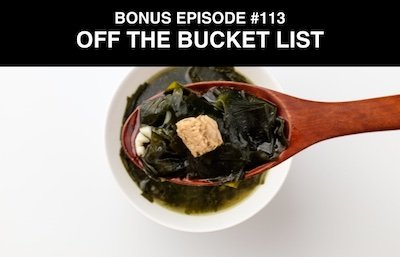
It’s not customary to eat birthday cake, at least traditionally, historically. What is historically and traditionally customary to eat here is a kind of seaweed soup called miyeokguk.
And usually, they’ll eat this soup for breakfast, I think, usually. But we ate it for lunch on my wife’s birthday. It wasn’t breakfast in our house, but we ate it for lunch. And I prepared it for my wife.
So actually, on the surface, miyeokguk, seaweed soup, is not too difficult to prepare. Sounds pretty easy to prepare. You just add some dried seaweed, and you put the seaweed back into water.
And you can, I believe we call this reconstituting the seaweed. So, it goes from its dried state back to a wet, slippery state, like you’d see in the ocean.
So, you have to reconstitute the seaweed by soaking it in water for around 45 minutes or so. And then there is some beef. You put little chunks of beef in the soup. And there are some other ingredients as well.
Some soy sauce, some… I don’t even know how to say it in English. It’s kind of anchovy liquid. In Korean, we call it myeolchiaek. But I don’t know what we’d call that in… I guess it’s kind of like a fish sauce.
Let’s call it fish sauce in English. Some fish sauce in there, some salt, and just some basic ingredients like that. It’s pretty simple on the surface.
But actually, my wife told me that this is quite a high-level dish to make, and not so easy to do.
Because this is a customary birthday food, I’ve prepared this for my wife, I think, pretty much every year that we’ve been together.
But in years past, I’ve always cheated by buying a meal kit and just using a pre-prepared seaweed soup meal kit soup, OK? And it wasn’t bad. In the past, it was totally fine.
You can order these things online or get them from the grocery store. I think I ordered mine online last year, and all of the ingredients were fresh, and it was all measured out.
I just put it together, boom, and you had some, like, pretty good seaweed soup. But not blow you out of the water seaweed soup. So, this year, I decided, you know what?
The meal kits from years past, they were OK, but nothing special. And I think I can do a better job. So, I decided, I’m going to do it on my own. I’m going to try and make the seaweed soup for my wife.
And she was like, “Are you sure about that? You think you can handle it?” And I said, yeah, I got this. So, I went on to the Korean internet.
And I don’t know, this is something I want to ask you guys out there, because I know we have such a global audience, listeners from many different countries from around the world.
It seems like, at least here in Korea, there is Korean internet, and then there’s English internet. And they’re very different. Like, it’s weird, you know? Like, the Korean language internet has different websites.
You don’t use Google, you use Naver. That’s just one little example. And just the content is slightly different that you see from one version of the internet to the other version.
So, I wanted to find the real authentic recipe how to cook seaweed soup. So, I went on to the Korean internet, and I looked at a couple of recipes that I saw on some Naver blogs.
But then, I don’t know, you can read about something, you can read about a recipe. But these days, I actually prefer to watch a real cook do it on YouTube.
So, then I went over to YouTube, and I watched a few different cooking videos from some famous chefs, from some grandmas. You got to watch the grandmas when you learn how to cook.
Like, they really know how to do it. So, I watched some videos from some grandmas, and just some other vloggers, some cooking vloggers, I suppose, who made it.
And I kind of, you know, surveyed five or six different recipes, and I got an understanding. OK, I think this is how this is made. And then I just did it on my own.
So, I didn’t really follow a recipe as I was preparing the seaweed soup. I just went off of what I had seen earlier and read earlier, and my own kind of gut instinct. And I whipped up this seaweed soup.
I did have to go to the grocery store and pick up some ingredients. But then, yeah, I put it all together and made it for my wife. I’m not really good. Here’s one thing.
I think I’m not trying to brag or anything, but in my opinion, I think I’m OK at cooking. Like, not so bad at cooking. But one thing that I’m not so great at is plating and presentation.
That’s something that I struggle with. On the other hand, my wife is super good with this aspect. Her plating is chef’s kiss, we say, meaning really, really good.
So yeah, that is something that I struggle with is plating and presentation. But I tried my best to, you know, make it look good. And I also made some bulgogi, which is a kind of Korean beef dish as well.
And I made some rice, and I plated it as nicely as I could. And I set the table and then I went and got my wife. I said, “Wife, happy birthday!” Let’s eat the seaweed soup. And so, she was a little bit skeptical at first.
She looked with a little bit of fear at the seaweed soup sitting in front of her on the table. But she tried it, and she was pleasantly surprised.
And she was like, “Oh my gosh, how did you make this? Did you make this? It’s not from a restaurant. You did it?” And her reaction was really genuine. And she legitimately enjoyed the soup and thought it was really good and praised me for doing a good job.
And so, in the back of my mind, I didn’t tell her this. Maybe she’ll listen to this episode and find out the story this way. I don’t know. But I don’t think she knew that I had this item on my bucket list.
So, in the back of my mind, I was kind of like, “Yes, all right, I did it!” I crossed that item off my bucket list. I learned how to cook a dish, in this case, Korean-style seaweed soup. And I made it myself.
presented it to my wife. And she really had a genuine reaction. And she thought that it was delicious.
So, I was A) happy to celebrate her birthday. And B) I was happy that I could celebrate her birthday by cooking something that she really enjoyed. But C) also selfishly, also selfishly, I was happy that I was able to cross one of those items off of my bucket list.
So, I’m wondering about you. What are your items on your bucket list? And have you ever accomplished them? If you have, then I am sure that you know that it feels pretty good when you cross off some of these items off of your bucket list.
So, where you can tell me about your bucket list goals for the future is our Discord community. Our Discord community is the place where Culips listeners gather. We hang out together. We practice our English. We talk about all types of things under the sun.
And it’s just an awesome place to hang out and get better and stronger and more confident with your English skills. You can join for free. Just follow the link in the description for this episode. And we’d love to have you join us there. And yeah, hear about what’s on your bucket list.
So, for the completion code for this episode, let’s go with the word: “Seaweed.” Let’s do it. That’s kind of a random word. And yeah, so the completion code, what you should do is make an example sentence using this word: “Seaweed.”
By sharing it on our YouTube page or our Instagram page or our Discord community, you will signal to me and signal to other Culips listeners that you have listened all the way to the end of this episode.
And yeah, good luck. I’m very curious to see what kind of sentences we will have using this word, “Seaweed.” So, you know what to do. This is your homework for this week. Go, go, go.
And I’m looking forward to seeing those completion code sentences.
All right, that’s it for me for now, everyone. I hope you have a great week ahead. Happy English learning as always. And I’ll catch you in the next episode. Until then, goodbye.
