

Now the goal is that by listening to these stories, you’ll be able to immerse yourself in the English language and you’ll be able to build your fluency, increase your cultural knowledge, grow your vocabulary, and ultimately at the end of the day become a better communicator. And hopefully, you’ll be able to do that in a fun and entertaining way.
I’ll do my best here at least to be fun and entertaining. Anyways, today I’m going to tell you a little bit more about what I’ve been up to while I’ve been traveling in Australia. I’ve been in Australia now for a couple of weeks and today I’m going to talk about the last little part of my time that I spent in Sydney.
Right now, I’m actually in Melbourne but there are a few things that I didn’t tell you about during the time that I spent in Sydney. So, I’ll tell you those stories and I hope you guys don’t get bored of my travel stories. I hope they’re not too monotonous to listen to again and again and again. If they are, just let me know and I’ll try and switch up the content.
But I don’t know, it’s always a little bit stressful for me to try and come up with some stories to tell you during our bonus episode series. I think I’ve mentioned this before, but my life in general is pretty boring. I think I don’t do too many interesting things so I’m always a little bit stressed out like, “Ahh what am I going to share with the Culips audience this week?
What was fun or exciting or funny that happened to me this week?” But while I’m traveling, I don’t really have that issue because I’m doing so many new things and so many different experiences that I don’t do in my day-to-day life. So, I have all these stories to share with you and even though I’m not spending too too long in Australia, I could, you know, release like three months’ worth of Australian stories.
Of course, I won’t do that. I won’t share three months of travel stories with you, but I will do it for the next couple of weeks because well it’s what’s happening in my life and at least to me these are unique stories that are new, so I want to share them with you as well and I hope you won’t tire of them. So, expect a couple more weeks of travel stories everyone.
And before I get started, I do have a few announcements to make. The first announcement is that you might hear a little bit of background noise in this episode. I’ve learned that buildings and houses in Australia have quite thin windows. And the place that I’m staying at here in Melbourne has very very thin single-paned windows and that means that you can hear the traffic outside very easily.
And one of the most famous things about Melbourne is its iconic streetcars and tram system and so there are these streetcars everywhere. It’s a really wonderful public transportation system and I’ll probably talk about it more in the future but when one of the streetcars rolls by there’s a lot of rumbling in the background.
So, if you hear a rumble don’t worry it’s not your headphones breaking it’s just a streetcar going past. And even sometimes if a car drives by or even if some people walk by on the sidewalk, I can hear them perfectly clearly in the room that I’m recording in right now.
So, if you hear some people talking in the background as well then, it’s probably just some people walking by on the sidewalk. So please just keep that in mind and I’ll do my best after to clean it up and make sure the audio is as quiet as possible for you, so you only hear my lovely voice. So that’s the first announcement.
The second announcement is that there is an interactive transcript and a vocabulary glossary for this episode that you can get for free just by following the link that’s in the description. And there’s also a comprehension quiz for Culips members and I’ll post the link to the quiz in the member-only channel of our Discord server.
I think, in my opinion at least, the quiz is a very fun way to check out how much you’ve understood from listening to and studying with this episode. So, I definitely recommend that all members check it out and give it a shot. Now finally if you enjoy the English lessons that we make here at Culips each and every week then please support us by becoming a Culips member.
Without our members Culips wouldn’t exist so because of that we provide tons of great perks and benefits to our members. Things like transcripts and full study guides for all of our episodes, ad-free audio, exclusive bonus content, and extended conversations for many of our episodes. What else? There are member-only live streams happening each month.
There’s our member-only series The Fluency Files. There’s our special member-only channel on Discord as well. So, we really try to give back as much as possible to our supporters and to our members because as I said we couldn’t do Culips without them. So, thanks to all the members out there listening right now. A special shout out to you guys. We love our members.
And for anyone who would like to sign up, become a member, and support Culips then just visit our website Culips.com, and you can sign up or you could just follow the link that we’ll put in the description to sign up and become a Culips member today. So, with all of those announcements out of the way, with that being said….
Actually, speaking of our Discord community, many people have asked the question, “Wow Andrew says that phrase a lot with that being said.” And I guess it’s a difficult phrase to understand, “with that being said.” And why don’t I quickly explain it right now.
To be honest, I think I use it more in the podcast than I do in my real life because when you’re having a conversation with someone else there’s a lot of give and take and flow to the conversation, right? You say something, the people who you’re talking to respond, and there’s back and forth. But when I’m on the podcast, if I’m doing the bonus episodes here by myself, well then, I need to direct the flow all by myself.
I need to organize the episode and follow a path from the start to the end of the episode. And also, if I’m recording with one of my co-hosts with Kassy, or Suzanne, or Anna, it’s kind of my job and my responsibility to control the conversation and to make it flow. And so, because of that I use this transitional phrase a lot which is, you guessed it, “with that being said.”
And it’s a phrase that we use when we want to control the flow or the direction of a presentation, or speech, or even a podcast episode. It’s just communicating to the audience that we’ve finished talking about one thing, in this case the announcements that I wanted to make.
I finished talking about the announcements and now we’re going to transition into the main part of the episode which is the stories that I’ll tell you about my time in Sydney. So, if you’ve been wondering about that phrase that you’ll hear me use often, probably almost each week on Culips, maybe even multiple times in an episode, I say “with that being said.”
It’s just a transitional phrase to go from one part of the conversation, one part of the presentation, one part of the podcast, to the next part. And I would say this expression is really great for, you know, doing those things that I just mentioned. For making presentations or giving speeches or perhaps you are organizing a meeting, chairing a meeting, something like that.
But in everyday conversation we wouldn’t use it as much. I don’t want to say we never use it, but we wouldn’t use it as much as we would in those other kinds of situations. So, I hope that clears things up. I hope you understand that expression clearly now. And with that being said, I couldn’t help myself guys, sorry. With that being said, let’s get started with my stories. So here we go. Enjoy.
I’m wondering when you think of Sydney, Australia, what is the first thing to pop into your mind? Well, if you think of Australia, you probably think of maybe a koala or a kangaroo, right? But if you think of Sydney specifically, well there’s a chance that you might think of the Olympic Games.
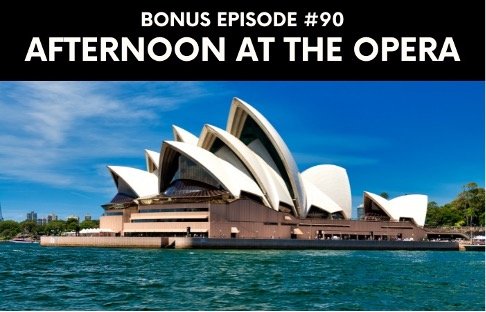
There’s also a chance, I would wager a bigger chance, that you would think of one of its most iconic buildings, the Sydney Opera House. For me, when I think of Sydney, that’s exactly what pops into my head, the Sydney Opera House. Now I learned after visiting the Sydney Opera House that it was designed by a Danish architect back in the 60s.
Now that architect’s name, I’ll probably butcher the pronunciation of this name, and if we have any Danish listeners out there, to be honest, I don’t think we have many Danish listeners because Danish people are pretty good at speaking English already, so I don’t think there are too many of them listening in Denmark, but if there are, guys, please let me know about the pronunciation of this name. I think it is Jørn Utzon, OK?
That’s my best shot at the pronunciation. But anyways, he was the architect who originally designed the Sydney Opera House, and then it was completed with a team of Australian architects headed by a guy named Peter Hall. And it was formally opened by Queen Elizabeth II in 1973. It’s located right in the foreshore of the Sydney Harbour, and to see it in person was just really amazing.
It’s quite the structure and incredible, really. So, one thing that I thought could be fun to do while we were in Sydney was to go to the Opera House and not just look at it from the outside. I knew, of course, that we would be doing that, to go walk around the harbour and see the Opera House and take some photos and do the touristy thing.
Of course, we were going to do that, but I also thought that it would really be fun to go inside, either for a tour or to see a performance there. And I knew that even though it’s an opera house, there’s also many other kinds of performances and shows that take place there, concerts by other bands and other kinds of shows as well.
So I went to the website, the Opera House website, to try and book some tickets either to the opera or to a concert, and I was really sad because I noticed that one of my favourite American bands, this band called Wilco, they’re a wonderful band from Chicago, and they’re going to be playing there soon, but not until next month.
So, we were a few weeks too early to see Wilco, and in fact, I couldn’t find anything that was playing at the time that we were in Sydney. So, I was really disappointed that I couldn’t find any tickets to a performance of some kind, either an opera or a concert.
So, I kind of just gave up on that idea, but then a few days later, my wife suggested the same idea, that we should go to the Opera House and either watch a concert or a performance or an opera, and I told her, “Well, I looked at the website, but I couldn’t find anything.” And she didn’t believe me. She’s like, “That can’t be. We’re in Sydney for nine days.
You’re telling me that during the whole nine days that we’re there, there’s nothing to watch at the Opera House?” So, she went and took a look again, and she was right, as she often is. I totally missed that there was actually an opera happening during the time that we were there, and she went ahead and booked some tickets.
So, we did it. It wasn’t in the main bigger theater, but it was in a smaller room of the Opera House, which is called the Joan Sutherland Theater. Now, to be perfectly frank with you, I don’t know much about the opera at all. Of course, you guys know I’m a huge music fan.
I love, I think, all genres of music, but if you ask me about which genre of music I listen to the least or I know the least about, I’d probably answer opera. Like, I just don’t know too much about it. I know there’s a lot of skill involved in singing opera, but I don’t know too much about it other than that. So, I have to say my expectations for the opera were set pretty low.
I was more excited about going into the Opera House and checking out the inside and just, you know, visiting and that whole experience. I was way more interested in that than I was in watching the opera. But the opera that we ended up seeing was called “La Traviata” and I think that is by a very famous opera writer named Verdi.
And so, yeah, we watched that opera and I have to say I was blown away. I really enjoyed it. I was impressed not only by the venue, which was amazing, but also by the talent of the singers and the orchestra and the conductor of the orchestra. It was just a spectacle in the truest sense of the word, and I really, really enjoyed the opera.
Of course, it was all in Italian, so I didn’t understand much, but there were some subtitles displayed for us and I don’t think they translated everything word for word because the singer would sing for like 30 seconds and there would be one little, short sentence of the subtitles on the subtitle screen.
So, I don’t know if we were getting the full picture of what the singers were communicating. However, it was helpful at least for following the outline of the story and I also did go to Wikipedia to read the summary of the story before we watched the opera so I could follow along even though it was in a foreign language that I know nothing about. Now, we watched the opera in the afternoon.
It was a matinee show and one of the things that was really, really fun about going to the opera house and watching the opera was people watching. People watching. Because the level of sophistication and the fancy outfits of all the people who came to watch the opera was wonderful. Most of the people that attended the opera, to be honest, were senior citizens like older folks.
There were a few people who are younger than my wife and I and a few people who are around the same age as my wife and I, but I’d have to say that like 80 to 90 percent of the people watching the opera were senior citizens. However, they were dressed to the nines. They went all out.
There were some really, really stylish people wearing really unique outfits, wonderful dresses and suits and people mingling in the lobby drinking champagne before the opera and during the intermission as well, which is what we call the break in the middle of a performance.
So, during the intermission when we had a 20-minute break everyone went back out into the lobbies and people drank champagne again. I didn’t drink any champagne because a) it was expensive and b) I think if I had a glass of champagne in the middle of the day like that, I probably would have either gotten a headache or fallen asleep during the middle of the opera.
So, I abstained. I didn’t drink any champagne. I had a glass of water though and I also mingled around a little bit. So that was just really fun.
And then after the show, right outside of the opera house is a place called the Opera House Bar, which is a bar/restaurant and it’s right beside the opera house with a beautiful view of the harbor and the harbor bridge and it’s kind of like one of those things that you must do if you go to the opera in Sydney is that after the show you go to the Opera House Bar and you can enjoy a meal and a drink and that’s what we did.
We went there for lunch, and we really enjoyed that meal. To be honest, the food in Sydney overall didn’t really impress my wife and I. I don’t know if we just went to the wrong restaurants or what but overall, I’d say it was like so-so at best but at the Opera House Bar the food was actually pretty good.
So, we really enjoyed that meal and then afterwards we just walked back to our hotel and that was our opera experience. Now aside from watching the opera there are so many other things that I did in Sydney. I did a lot of running. The weather was so good, and I had some free time when my wife was busy doing some other business that she had to do.
So, I had some free time to myself, and I used most of that free time to go running. I did this really cool run called the Seven Bridges Run which is a route that I found online on Strava and the route I don’t know if it’s like a popular running route in Sydney or not, but I have the feeling that it’s a pretty popular run.
It’s around 22 or 23 kilometers if I recall correctly and it takes you through some of Sydney’s most beautiful locations, very picturesque, and over seven of its iconic bridges including the Anzac Bridge and the Harbour Bridge which is great for looking at the Opera House and the Harbour. I took some beautiful photos from that location on the bridge of the Opera House and the Harbour.
I’ve actually posted that photo to our Instagram already so if you want to see just how amazing of a photographer I am, then you can check that out on our Instagram. Now, that run was actually a little bit stressful for me because I think I did it like the first day that we arrived in Sydney. I was like, “I’m gonna go explore the city.
I’m gonna do this big run across all of these bridges and through these different neighborhoods!” And the day before I did that run, I updated the operating system of my phone. I use an iPhone and right before we left to go to Australia there was an update available. So, I updated my phone.
And I don’t know if you guys have ever had this happen to you. I don’t know if this is just something that is actually happening or something that is all in my head. I’m not sure. However, before I updated, I always had really good battery life with my phone. My phone’s not very old and I’ve always been able to use it for a whole day without any issues at all.
And I’ve never had to charge it in the middle of the day or anything. However, when I went for this run, I was about I don’t know 10 kilometers into it or something and suddenly I noticed that my battery was getting low. And I got a little bit worried because I was like, “Hmm this is unusual. Usually, I don’t have this kind of battery issue with my phone.
I should just keep my eye on my battery to make sure that my phone battery doesn’t die. Because if it dies while I’m on this run far away from the hotel, then I might have some problems.” Now I have to say that I was using a GPS app on my phone so that I could follow the seven bridges running route because it’s not clearly marked. It’s just like some course that somebody made up, I think.
It’s not an official trail in the city so there are no signs or anything, so I did have to follow the path on my phone. After I noticed that my battery was dying quickly, then I kept a close eye on it, and I noticed that it was going down really really quickly.
So, it was like at 30% and then 10 minutes later when I checked it was at 20% and so at this point I started to get stressed out because I was about, yeah, halfway into the run maybe 12 kilometers or so into the run. And it wasn’t the most straightforward route. I was doing a lot of turns and stuff and I think I could have retraced my steps to find my hotel again or even asked somebody for directions.
You know I do speak English and Australia is an English-speaking country, so it wouldn’t have been like I was totally, totally majorly in trouble. However, I still didn’t want to get lost, and I didn’t want to be without my phone or my way to contact anybody or even like the address of my hotel. So, I was starting to get stressed out. So, I turned off all of the functions on my phone like the wi-fi.
I kept on the GPS because I needed it to see where I was going. You know probably at this point it would have been smart for me to just turn around and go home following the same path that I had already taken, right? But that would have been so disappointing, and I did want to cross the harbor bridge which was the final bridge in this series of the seven bridges that I had to cross.
So, I just turned off all of the functions, made sure all of my apps were closed. I was listening to music on my phone while I was running so I turned the music off and I turned my screen brightness down to zero and I just crossed my fingers and hoped that I could get back to my hotel, to my wife, without getting lost in the middle of nowhere. The first half of the run was really nice.
You went through like Darling Harbor I believe it is called this place Darling Harbor and across the Anzac Bridge and through some really nice suburbs.
Really well-to-do suburbs in Sydney and so that was wonderful. But then around the halfway mark suddenly you’re running beside this highway and so for the final half of the run most of it was actually beside a highway or another big busy main road and so for that reason I actually wouldn’t recommend this run. The first half is very beautiful, the second half is like meh.
So-so at best but it ends with a bang because suddenly you go off of that kind of ugly-ish main road you’re just like running beside a lot of traffic and there’s a lot of fumes and you know traffic noises. Cars honking their horns and that kind of thing. And then you come back into the city, and you cross over the harbor on the harbor bridge, and you can see the opera house and see the ocean and see the city and that made it worth it.
And it also gave me like a nice introduction to what Sydney’s like. Like, I saw the really beautiful parts of it. I saw the not so beautiful just regular city parts of it so that was pretty cool. Aside from that I also did a lot of running in one of the main parks in Sydney called Centennial Park. It’s one of Sydney’s oldest and largest parks and it’s a really popular place to go and run.
There’s this big 3.5-kilometer circuit, a loop in the middle of the park that was really really fun to run on. Lots of other runners out there. And it felt great to run among so many other people. In Seoul when I go running, I do pass other runners but not too many.
Especially, you know, now it’s the winter, so I don’t see too, too many runners when I run in Seoul, definitely not to the same level as in Sydney. So that was really fun and just a good way to kind of spend some time seeing what local people do so I really enjoyed that.
And aside from that, my wife and I also went to the famous Sydney Fish Market. We ate some fresh seafood there. We had oysters, some sashimi: some salmon, some tuna, and lobster as well. You order your food inside the market and then there’s an eating area inside the market but also outside the market as well.
And personally, if I have a choice to eat inside or outside, I’m always eating outside as long as the weather is not terrible. And the weather was nice that day, so we decided to sit outside and eat outside, but it was a little bit stressful as well. A lot of stress on this trip!
It was stressful because there were so many seabirds around the market, there were seagulls, there were these other birds that I think are called spoonbills. I’ll have to look at their name online and if I can find…
I think I took a picture of one if I can find that picture, I’ll post it on Instagram for you guys to see but they have these long bills and they’re white birds and yeah, they’re all over the place in Sydney and they like to peck around at the ground and eat garbage or whatever they can find, I think they’re scavengers.
So, there’s seagulls, there are these other birds which I think are called spoonbills, and there were pelicans as well. This was the first time in my life that I’ve seen a pelican in real life. They are huge, to me in my opinion they’re a little bit scary, they have these big eyes that look soulless.
That’s what my wife and I were saying it was the first time that she saw one as well she’s like, “Oh it looks like there’s no soul in these birds like they’re just big robots or something!” So, they were a little scary as well and so when we were eating our seafood, we were just like eating really quickly trying to get it down before the birds would come and swoop in and steal it.
When I was in elementary school, I had a traumatic experience probably in the second or third grade. Look at me, I’m speaking like an American. In Canada, we say in grade two or grade three. Americans say second and third grade, Canadians we say grade two, grade three. So, either in grade two or grade three, I went on a field trip to Stanley Park in Vancouver.
Many of our listeners who have visited Canada or visited Vancouver you guys will know about Stanley Park.
So, I was there for a field trip with my class and while I was eating one of the sandwiches that my mom prepared for me in my lunch box, you know, I was just holding half of the sandwich in my hand, and while I was just holding it in my hand ready to take a bite of the sandwich, a big seagull swooped in and grabbed the sandwich right out of my hand.
So, the seagull ate well that day and I… I guess I only ate half a sandwich because the other half was gone. So, I didn’t eat very well that day, but that trauma has stayed with me ever since that day back in grade two or grade three.
So, I kept that memory in mind and made sure that it didn’t happen again, and my wife was actually really good at scaring off the birds if they came around to check out what we were eating she scared them off very quickly. And so, we were able to enjoy our meal at the fish market. We also did so many other things in Sydney.
I don’t have time to talk about everything here, but we really had a great, wonderful time. And now, like I said we’re in Melbourne and we’re going to be here for the next little bit so probably in next week’s bonus episode I’ll give you some updates about what’s going on during our time here in Melbourne.
But for now, I think I’m going to wrap things up because there is a helicopter flying around outside right now and as I mentioned the walls are paper thin, the windows are paper thin here in the place where I’m staying at.
So, I want to make sure that you guys are not interrupted by the whirling of this helicopter so I’m going to wrap things up here now everyone. But thank you for listening. If you made it all the way to the end, then I want to say congrats on completing an English study session with me today, you did a fantastic job.
So, we’ll be back with another new episode here pretty soon in the next few days, but until then, take care and bye for now!
