


And I know many Culips listeners actually prefer shorter content rather than me just rambling on and on and on for a long time. So, what I’m going to do is break it up. And maybe over the next three or four bonus episodes here, I’ll tell you about some of the highs and lows, because there were some really low points on this trip as well. There were amazing times and not so good times.
So, I’m going to tell you about the highs and the lows about my time in Hawaii and in Japan over the next few weeks here. So, I hope you will enjoy listening to my travel stories. And today we’re going to focus in on Hawaii. It was an awesome time in Hawaii. And I’ll tell you about some of the things that I got up to during that trip in this episode.
But before we get started, I want to let you know that there is an absolutely 100% free interactive transcript and vocabulary glossary available for this episode. In my opinion, they are really, really great tools for improving your English fluency. The interactive transcript allows you to follow along with every word that I say.
And you can click on any word to listen to the audio from that point. And if you want to do some shadowing practice, even you could repeat a sentence over and over again by just clicking on the start of the sentence, listening to it, and repeating after it to improve your pronunciation. And the transcript is made by me. It’s not made by AI. It’s 100% human checked.
So, it takes actually quite a long time to do the transcript. So, I hope you’ll check it out and use that tool because I do think it is worth looking at. And the vocabulary glossary as well, 100% free for everyone. I go through the episode after I finish recording here, and I’m going to choose maybe 10 to 15 words or expressions or phrasal verbs that I think you need to add to your vocabulary.
If you want to hit the next level with your English. If you want to become a better speaker with a bigger vocabulary, if you want to understand more content in the future, you’re going to need to add these words, phrases, expressions to your vocabulary. So, I’m going to choose some that are important for you to know.
And I’ll explain them in the glossary and give you an example sentence as well. So, all of this is free, and you can check it out by clicking the link in the description for this episode. And we also have a Culips membership option here as well.
And if you are a Culips member, then we’re going to give you a comprehension quiz just as a way to say thank you to all the Culips members out there for their support. And guys, if you would like to support the work that we do here at Culips and allow us to keep making awesome English lessons for you each and every week, then please sign up and become a member.
Once you’re a member, you will get access to all of our tools, and services, and benefits, and bonuses, that we create to help you improve your English fluency. So, this includes things like helpful study guides for each episode that we make.You’ll also get to join our speaking classes. So, you can listen to one of our podcast episodes.
And then after, you join with one of our expert teachers and other Culips members and we’ll talk about that topic. So, you get your listening practice, you get your intense study with the study guide, and then you get a chance to share your opinion and to speak with other members of our Culips community. So that’s something you get as a member.
You’ll also get ad-free audio. You’ll get our member-only series, The Fluency Files. And there are other benefits and bonuses as well. So, you can sign up and become a Culips member today for a very, very affordable price actually, just by visiting our website, Culips.com. And yeah, thank you to all the members out there for your support.
Guys, we love you and we couldn’t do Culips without you. So, thank you so much. All right. I think it’s time for us to get started with my story today about visiting Hawaii and some of the touristy things that I did there in Hawaii. So, I hope you’ll enjoy this story. Let’s get started right now. Here we go.
Hawaii is amazing. It is one of the coolest places I’ve ever visited. And in fact, this trip was my second time visiting Hawaii. The first time that I visited Hawaii was a long time ago. And I visited one of the smaller, lesser-known islands, I suppose. It wasn’t as much of a tourist destination.
But this time when I visited Hawaii, I went to Honolulu. And my wife and I spent one week in Honolulu, right by Waikiki Beach. Waikiki Beach is one of the most famous beaches in all of the world. And I have to say that this area is very, very touristy. There are tons of travelers and visitors from all around the world. Lots of hotels, lots of restaurants, lots of shopping.
It’s a pretty touristy place, but the vibe is cool. I like the vibe. And it was a really nice place to spend a week. We were pretty close to the ocean. We didn’t stay right on the ocean, but we were only about a block away from Waikiki Beach. And so yeah, it was a cool place to take a walk in the morning and a walk in the evening. But during the main part of the day, we were very busy.
And we got up to some activity each day of our trip there. I don’t think there were any days that we just hung out and were beach bums and relaxed. Every day was go, go, go. And from the moment we arrived in Honolulu, we hit the ground running. We were really busy and active each and every day.
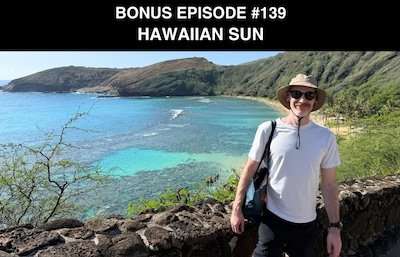
I’m gonna tell you about two of the activities that we did that stood out to me, that were really amazing, and that were also pretty standard tourist activities, that I think many, many people do when they visit Honolulu. So, the first thing that I want to talk about is snorkeling. Snorkeling in a place called Hanauma Bay, Hanauma Bay.
And this is a bay that is about a 30-minute drive away from the main Waikiki Beach area. And it is absolutely gorgeous, guys. I’m gonna share some photos of Hanauma Bay on our Instagram page. And if you’re watching the YouTube version of this episode, I’ll also put some photos and videos in the background here.
So, you can see and get a visual about what I’m talking about as I tell this story. But Hanauma Bay, oh my gosh, absolutely amazing. So, this was my second time visiting Hawaii, but like I said, my first time in Honolulu. However, my wife… and we traveled together. This was a great, awesome trip that I had with my wife. I gotta say she is an amazing travel companion.
We didn’t get into any arguments or fights or anything like that. The whole time, it was just a really, really great time that I got to spend with my wife. And I don’t think that I could travel with anybody else and never get into any fights or arguments or even be upset a little bit.
If I were even to travel with one of my best friends or family members, I think at some point there would probably be a little bit of a disagreement. But my wife and I are perfectly compatible, I think, when it comes to travel. We’d have to ask her that and see if she has the same opinion. But in my opinion, we are very compatible travel buddies. So yeah, that was great.
Anyways, she had visited Honolulu one time in the past. So, this was her second time in Hawaii also, but she had visited Honolulu before, so she was kind of the expert. And it’s interesting in this kind of situation. Of course, regular Culips listeners, you guys all know that my wife is Korean and I’m Canadian.
So, visiting a place like Hawaii where they speak English and everything is in English is really, really easy for me. You know, it’s just like no problem. I speak English, the language there is English, it’s great and convenient in that way. However, for my wife, it’s a little bit different, right? She’s Korean, she speaks Korean.
She, of course, can speak English as well to an extent, but she’s kind of at the intermediate level of English. So, it’s a little bit of a challenge. Everything is in her second language when she visits a place like this. But since she had visited before and knew about some places to go and things to see and restaurants to eat at, she was kind of the leader on this trip.
And she planned a lot of activities for us. One of the things that she had done on her previous trip was go to Hanauma Bay and go snorkeling. And she said it was an absolutely amazing experience for her and she wanted to do it again. So, I was down. And actually, when I had visited Hawaii previously as well, I went snorkeling in a different place and it was really cool.
So, I was excited to visit this bay and do some snorkeling. So, we actually brought, and maybe in retrospect this was kind of a dumb idea, but we actually brought our snorkeling masks, our snorkels, our flippers, that we put on our feet. And “flippers” are those big things that you can put on your feet to help you kick in the water and propel you forward. A whole snorkeling set.
We actually brought that with us from Korea to Hawaii. And, I don’t know, it seems like a little bit excessive to me, but my wife said, “I think it’s gonna be cheaper here to buy a snorkeling kit in Korea and take it with us to Hawaii rather than buy one in Hawaii.” And, I think in retrospect she was probably correct because the prices in Hawaii are quite expensive.
And, you’re also paying in American dollars, which is a little bit painful for us who live in Canada or Korea with the exchange rate these days. So, we brought our whole snorkeling kits with us from Korea to Hawaii. And when it was time to go snorkeling, we prepared our bags and went to the bay. And to get into the bay, you actually have to make a reservation.
You can’t just show up and go snorkeling anytime you want. It’s a very protected area. There are some endangered species that live there, and it’s really, really protected. So, when you arrive at the bay, first they’re gonna check and make sure: Do you have a reservation to go in? And you also have to pay an entrance fee and go through an orientation as well.
So, once we got to the bay, we took some photos and we just enjoyed the amazing scenery. Guys, this bay is absolutely beautiful. And of course, a bay, for those of you who don’t know, is just an area of the ocean where the ocean comes in and is kind of protected. It’s like a circle. You could draw a circle, and the water just comes into this circle.
And so, the water in the bay is much more calm and still compared to the wild ocean. And the ocean surrounding Hawaii is pretty rough and wavy. And I don’t think you’d want to go snorkeling in the open ocean unless you are very experienced. And I’m not an experienced diver or snorkeler or ocean swimmer. So, going in the bay, where it’s protected and the water is calmer, is much better.
So, after the orientation, we made our way down to the beach. And the first thing that we had to do when we arrived at the beach was find a good spot to hang out, and lay our beach towels down, and kind of make our base on the beach.
And for me, I’m a burner. I’m a really pale guy. And if I spend too much time in the sun, I’m definitely gonna burn. I’m gonna get a nasty sunburn. I’m gonna turn red like a tomato, and I’m gonna have a really bad time for the rest of the trip as well, because I won’t be able to spend any time in the sun without having a painful experience.
So, finding a shady spot on the beach is super, super important for me. But my wife, on the other hand, she loves tanning. And she loves lying out in the sun. And she’s, like, completely the opposite of me in that regard. So, we had to try and find a spot that, kind of, checked the boxes for both of us. A shady spot for me, and a sunny spot for her.
And luckily enough, there was this perfect spot under a tree where half of it was in the shade and half of it was in the sun. And so, we were able to hang out there. I put my beach towel down in the shady part, and she was in the sun. And there were some other shady parts around us, and it was so funny because all of the people that were hanging out in the shade were Koreans.
For whatever reason, a lot of Korean people, I think my wife’s like an exception. Maybe she’s not the only Korean who likes tanning and hanging out in the sun, but many, many Korean people actually don’t like this. And they prefer to stay in the shade. So, it felt like I was almost back in Korea because I heard people speaking in Korean, and all of the people around me were Koreans.
And like, the tourists from other countries and the American people who live there were, like, all in the sun. So, that was kind of a funny moment. But to tell you the truth, we didn’t spend too much time on the beach. Pretty much as soon as we arrived, we hopped into the water and got snorkeling. And, the water in the bay, as I mentioned, is pretty calm and chill.
And it was a good thing that was the case because I’m not a super strong swimmer. I’m decent at swimming, but not, like, super, super strong. Also, this was only one of a handful of times where I’ve gone snorkeling in the ocean. And so, swimming with the flippers on my feet and breathing through a snorkel, that is something that I’m not really accustomed to.
So, it was nice that the water was so calm that it wasn’t really a challenge to do that at all. As soon as we got into the water, guys, it is crazy, as soon as you enter the water, you get like up to your waist deep. Then you can dive under the water and do some snorkeling. Pretty much as soon as you go under, it is incredible. There are so many different kinds of fish and ocean life.
We saw just hundreds and hundreds of different species of fish. Some small, tiny little ones, some big ones, ones of all different colors. I think it was the parrotfish, I believe, is the name of the fish species that is super, super colorful, and I saw that. You can swim along the coral reef. And, the reef is challenging because the water is pretty shallow. It’s not very deep.
It only maybe… well if you go out farther, I’m sure it gets deeper, but I stayed in the shallow end. So, maybe the water was only up to my shoulders, and the coral reef is probably about a meter high. So, you have to be very careful because this is a protected wildlife area. And the coral is extremely fragile. And if you touch it, the coral will actually die.
So, you have to swim and snorkel in this very shallow area. The water from the top surface of the water to the ocean floor, like I said, was probably about the distance from my feet to my shoulders. So, about, I don’t know, a meter and a quarter or so. However, the distance from the surface of the water to the top of the coral is pretty shallow, like maybe only 50 or 60 centimeters.
It’s not very much. So, swimming in that area is a challenge. You have to be very careful not to touch the coral at all. And the fish, also, you don’t want to touch the fish. But they’re so close to you, and they’re everywhere, that you have to just, sort of, almost float on the top rather than swim. But it was absolutely amazing. It’s incredible.
When you just look at the ocean, you don’t really know how much wildlife is there. But then as soon as you put your head under the water, it comes alive. And really, really cool. So, we snorkeled for a long time. I think maybe I was out there for an hour, an hour, and a half? It seemed like a really long time. Eventually, I started getting beat up by the ocean. The ocean was beating me up.
I had a slow leak into my snorkeling mask, so I would get water in my eyes. And saltwater in your eyes after a while gets pretty unpleasant. My eyes started to sting and go red. Also, the flippers I was wearing on my feet started to hurt my feet. So after about an hour or an hour and a half, then I took off to go back to the beach and just hang out on the beach.
But my wife was like, “I’m staying out there.” She wanted to keep going. She probably went for like another hour. She really, really enjoyed it. She had a great time. And after, then she came back, we spent a little bit of time on the beach and just enjoyed the amazing views. And that was pretty much our time in Hanauma Bay. I think we were there for about four or five hours overall.
And it was perfect timing because after we got packed up and got changed and were heading back to our hotel, then it started getting very cloudy and rainy and a little bit windy. So, we had this, like, amazing morning at the bay going snorkeling, and then in the afternoon it was… the weather wasn’t so good.
So, it was a nice excuse for us to just go back to our hotel and chill for the afternoon. And I gotta say, after spending all that time in the ocean and on the beach, we were a little bit wiped out. So, it was nice that we could just go to the hotel and chill and didn’t have to worry about doing something else and wasting our precious vacation time because of the bad weather.
The second really cool thing that we did in Hawaii that many tourists and visitors do is going to Diamond Head. Diamond Head is right close to Waikiki Beach. And it’s this huge crater that was formed by volcanic activity thousands and thousands of years ago. And you can do a hike up the crater.
And once you get to the top, then there are just amazing panoramic views of the Waikiki Beach area, of the ocean, of the surrounding areas. And oh my gosh, it is just super, super beautiful. And again, to visit there, you must make a reservation. So, the best time to visit apparently is in the morning. And you can see the sunrise over the ocean.
And apparently, it’s just very scenic and beautiful to do it in the morning. And also, you can beat the heat. It’s not so hot if you do it in the morning. You can climb up the crater when the sun is still down. I guess it’s probably a little bit hard to hike in the dark. Probably you need a flashlight or something. But yeah, once you get to the top, then you can see the sunrise and it’s not so hot.
So of course, that’s when I wanted to make a reservation, was for early in the morning. But I honestly didn’t know that you needed to make a reservation. And when I was researching it, then I found out that, yes, in fact, you do need to make a reservation. And so, I think at that point, we only had a few days left in our trip.
And I was looking for a time slot that we could do it during one of our remaining days. And the only available time slots were in the afternoon. So, the morning time was completely sold out. That kind of sucked. We didn’t get to do the sunrise hike. But in fact, it was OK. It still turned out to be an absolutely incredible experience. We took a bus from our hotel to the trailhead.
And then you have to go… Again, they’re very serious about checking that you made your reservation. You can’t just sneak in. I was, I was wondering about that. I was like, can we just sneak in? Not that I think I would have done it anyways. But I think it’s pretty impossible to sneak in. They check your reservation very carefully.
But we made our reservation and we had to pay a small fee. Maybe I think $6 to do this hike. But once you arrive there, then it takes maybe about an hour to an hour and a half to get from the bottom to the top of the crater. And I would say that it’s a pretty easy hike. In fact, I didn’t even think it was a hike. I was joking with my wife that it’s more like a nature walk.
Because compared to some of the hiking that we do here in Korea with like really steep trails, this was pretty gentle and easy. And there were lots of stairs and stuff as well to help you get to the top. So yeah, it was just a really nice day. Perfectly sunny. It wasn’t too hot at all. But my wife and I had a nice time walking to the top. And the views once you get to the top are just incredible.
This panoramic ocean view. And again, I’ll put some photos and videos on Instagram and in the YouTube version and on our Discord community as well. So, you guys can check out and get a visual. Because a picture says a thousand words. And the adjectives that come to mind when you’re talking about an amazing, amazing view like this are like: beautiful, incredible, amazing, right?
But that doesn’t really describe very well just how gorgeous and just how beautiful the nature really was. So yeah, we got to the top of the Diamond Head hike, and we took some photos. And then it was time to descend. We got to the bottom and actually there’s a little gift shop at the entrance and the exit. And before we went on the hike, my wife and I bought some hats.
Some Diamond Head memorial hats just as a souvenir. And also, for me, as I’d mentioned earlier, I’m a burner. So, I got this hat that has like this big piece of fabric that runs down the back to protect your neck from getting sunburned. So that was a very vital piece of kit. For me, a very important hat to wear so that I didn’t burn my head or my neck or my ears or anything like that.
And yeah, I think covering up is the best way to prevent a sunburn for me. So, I was pretty covered up. But yeah, we had a great hike. And when we got down to the bottom, we had a little picnic. We brought some snacks with us and there’s this little picnic area. And it was so cute because there was a sign that said, “Don’t feed the mongoose!” Don’t feed the mongoose.
We’re like, “There are going to be some mongoose here? OK, I’m not sure.” Anyways, as soon as we sat down and we got out our snacks, then I guess the mongoose that live in that area, the picnic area is beside some higher-grass area. And there were like three or four little mongoose that came out to check out and see what we were doing.
But we followed the sign’s instructions, and we didn’t feed the mongoose. But it was cool to see them. I always thought that a mongoose was like a fierce, dangerous animal. But they’re just like these little, long, kind of, rodents that were actually pretty cute. So, it was nice to see the mongoose, but we didn’t feed them. And then we walked back to our hotel.
It’s probably about a 30-minute walk. I thought we were going to have to take the bus. But we weren’t too tired after the hike even. And on the way back, we stopped, and we got some local Hawaiian food that was also really delicious. The hike left us hungry. The snacks that we brought weren’t enough. So, we had to stop and get a meal.
And I had just this really, really amazing salmon sandwich. Fresh caught salmon and grilled to perfection. Super delicious. And so yeah, that was another really great day and probably the two most touristy activities that we did in Hawaii. For the rest of the time that we spent, to an extent, we tried to get off the beaten path and to do things maybe that weren’t so, so touristy.
To see some of the more local areas of Hawaii and Honolulu. So, I’ll talk about some of those adventures in an upcoming Culips episode but for now, I gotta cut things off. I wanted to make this episode short and sweet, everyone, but that is hard for me to do. I ramble on and on.
But I think in the end, this is a good thing because the more I talk, the longer you get to spend with English and the longer you spend with English, the faster you will improve your fluency. So, congratulations and excellent job on making it all the way to the end of this episode. Thank you so much for studying English with me today.
And before I let you go, I have to share this week’s completion code with you. We’re gonna go with a phrase. I want you to share an example sentence using this phrase, this expression that I’ll share with you in just a moment and that will signal to me that you did it, that you made it all the way to the end of this episode, that you finished studying English with this lesson today.
You can share it on our Instagram, our Discord community, our YouTube page. And that will, yeah, show me and show other Culips listeners that you did it and you studied English. It’s kind of like an attendance check, right? You did it, here’s your attendance check.
So, the phrase that we are going to go with for this week’s completion code is: “Hit the ground running.” Hit the ground running. I told you at the start of the episode that my wife and I hit the ground running as soon as we arrived in Hawaii. And “To hit the ground running” means to not delay doing something.
As soon as you arrive somewhere, then you start working or start being busy or start being active, OK? Imagine that when you go to work, you hit the ground running as soon as you arrive at the office. So, this means that you get to your office and as soon as you arrive, boom, you’re doing those spreadsheets, you’re doing meetings, you are active and working hard right from the very start.
On the other hand, maybe some people get to the office, and they go to the staff room, and they have a coffee, and they talk with some co-workers, and they delay getting started. That is not hitting the ground running. But if you are very active right from the moment you arrive somewhere, then you hit the ground running and that’s what my wife and I did in Hawaii.
We hit the ground running. We got started and we’re very busy right from the moment that we arrived. So, that’s your completion code for this episode: “To hit the ground running.” Leave your example sentence in the comments and I look forward to seeing what you guys come up with.
All right, that’s it for me for today, everyone. Have a great week of English learning up ahead and I’ll catch you in the next episode. Until then, take care and goodbye.
