
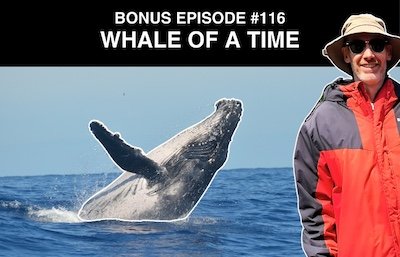


“To have a whale of a time” is an English idiomatic expression, which means to have an awesome or amazing time. You know, whales are really, really big animals, right? So, if you have a whale of a time, it means like the time that you had was so good and so gigantic, just big, and huge, like a whale. So that’s an expression for you right off the start of this episode.
And the title for this one, “A whale of a time.” As I mentioned, I’ll tell you that story a little bit later for the main story of this episode. But before I do that, I want to introduce myself. My name is Andrew, and I will be your host and your English study buddy for this episode. And what we do here in our bonus episode series is I just tell you some stories from my everyday life.
And I hope that by listening to these stories, you will be able to B.I.G.B. B.I.G.B is the motto for this series, the bonus episode series. And it’s an acronym, it stands for B, build your fluency, I increase your cultural knowledge, G, grow your vocabulary. And the final B is become a better and clearer communicator in English. So those are the goals that I’m trying to help you achieve.
And if you’re ready to try and achieve those with me, then hop on aboard, you’re in the right place. And we’ll do it together. Before we get started with the main story, though, I do want to let you know that there’s a free interactive transcript and vocabulary glossary available, you can get it just by following the link in the description for this episode.
And I hope you’ll find these tools useful and helpful for your study. And also, if you are a Culips member, then there is a comprehension quiz that we’ll provide for you as well. If you’re looking to take your English to the next level and support the work that we do here at Culips, I’d highly recommend that you sign up and become a Culips member.
You can find all of the benefits and bonuses and special things and helpful learning tools that we provide our Culips members with by following the link in the description for this episode or visiting our website Culips.com where you can sign up and become a member.
And a big shout out and a thank you to all of the members out there who are learning and improving their English with Culips and who also support the work that we do. Without our members, there wouldn’t be any Culips, it would be impossible for us to continue. So, a big shout out and a thank you to all of our members out there. We really do appreciate your support, guys.
Other than that, there’s just one other announcement. And that is that there will be three speaking classes this week that we are hosting for our Culips members to practice talking about Culips content with a small group and with an expert English teacher. So, this week, guys, we are talking about the Simplified Speech episode that came out not too long ago, called “Decluttering your life.”
And actually, that was Simplified Speech episode number 200. A cool milestone for me. Wow, we’ve done 200 Simplified Speech episodes.
So, we’ll be talking about that topic in this week’s speaking classes, which will be happening on September 10th, September 11th, and September 12th. I will be hosting the September 12th class and Alina in Indiana, our other teachers will be hosting the other classes, you can see the exact time and the exact date on our website.
And I’ll put the link to the schedule in the description for this episode. So, you can find it easily. Because depending on the place where you live in the world, the time and the date will be different for everyone. So, I can’t say the exact time and date, but check out the schedule, make sure to choose your time zone at the top, and then you can see it displayed in the right time.
And the classes will be happening on Zoom so that Culips members from around the world, we can all gather and practice our English speaking together in a fun and supportive but also helpful way. So, I hope to see many of you in our classes this week. And without any further ado, let’s get started with this episode.
As I mentioned, I’m going to talk about whale watching and some of the other things I got up to during my recent time in Canada and visiting Vancouver Island. So, I hope you enjoy this story. Let’s get right to it. Here we go.
If you listened to the last couple of bonus episodes that I’ve uploaded here at Culips, you’ll know that I recently visited Canada. And I went there with my wife, but I went a week before my wife, I was lucky enough to have a little bit longer vacation than she was. So, I went a week ahead of her. And I spent some time visiting my family. I also had a quick stopover in Osaka, Japan on the way there.
And yeah, when I arrived, I went to my hometown Kelowna, I went on a cool camping trip with my brother to a hot springs, which I talked about last week in bonus episode 115. And yeah, just spent some time hanging out with my family for about a week before my wife arrived. And when my wife finally did come, we had a three-stage plan for our trip.
The first stage was visiting Vancouver Island. I went to university in Victoria, British Columbia, which is on Vancouver Island. And I spent a lot of time there. I have a lot of good friends there still who are living there. And it’s a really special place to me. So, I wanted to introduce my wife to Victoria and show her around Vancouver Island for a little bit.
So that was the first stage of our trip. And then the second stage was visiting my hometown Kelowna. And mostly just doing family things, spending time with family doing a little sightseeing, going to the beach every day, that kind of thing. That’s what we did in Kelowna, which was stage two.
And then finally, stage three was in Banff, Alberta. And then, well, maybe I’ll talk about that in next week’s episode or two weeks after, I have a lot of travel stories to share with you. But I’ll share all about that in an upcoming Culips episode. So don’t worry, I’ll share all the details with you.
But then after our time in Banff, which is in the Rocky Mountains in Alberta, then we went to Calgary and flew from Calgary back to Seoul. So, we started in the west and we moved our way east and then went all the way east back to Seoul. So, I’m going to tell you about the first leg of the journey, or at least part of it here. And that was visiting Victoria and going to Vancouver Island.
So, as I mentioned, I arrived about a week before my wife. And so, when my wife flew into Canada, she flew to Vancouver. So, I left my hometown Kelowna, and I took the long journey to Vancouver. Actually, it’s not that long of a journey. If you fly, it’s about a 50-minute flight. And if you drive, it’s quite a longer distance.
It’s like a five-hour drive probably from Kelowna to the Vancouver airport. So, I took a flight, and I met my wife at the airport. It was actually pretty good timing. My flight arrived just like an hour before her flight arrived. So, it was good. I got off the plane. And then I worked my way from the domestic terminal to the international terminal and the international arrival area.
And I had to wait, yeah, maybe about 30 minutes until she arrived there. But it’s kind of fun doing some sightseeing in the international terminal. And an airport is really a place where you can see lots of emotions on display. If you’re ever around the departure area, you can see so many sad farewells, sad goodbyes, right?
People saying goodbye to their friends, to their loved ones, to their family. And you see a lot of these teary, sad goodbyes, it always pulls on your heartstrings a little bit. Well, the opposite is true if you hang out in the arrival section. And I think this was the first time that I had to wait for a considerable amount of time in the arrival section.
And especially the international arrival section, I think is a little bit more emotional than the domestic area. Because yeah, maybe from the domestic area, people see each other frequently. So, it’s not as emotional. But in the international, you know, you have family members coming from overseas from a long way away that you haven’t seen for so long.
And yeah, it was really cool to hang out there and see all of these happy faces and people being reunited. And so, I enjoyed my time hanging out in the arrival section of the airport, waiting for my wife, just people watching. It was a pretty cool experience. So finally, my wife arrives, and she arrived, she got into the airport around 6pm at night, I believe.
And so, we had that was just like the first stage of her journey that was finished was the long flight from Seoul to Vancouver, because we had to make our way to Vancouver Island. And from Vancouver to Vancouver Island, and to the city of Victoria, it’s not really too far. If you were to measure it, like on a kilometer basis, it’s probably under 50 kilometers, I don’t think it’s that far.
But the problem is it’s on an island, right? And so that means you have to go from the airport to a ferry terminal, you have to take a ferry, and then you arrive on Vancouver Island. But unfortunately, the ferry doesn’t go all the way to the main city, Victoria, it goes to this other place called Swartz Bay, which is another maybe almost an hour outside of Victoria. So, it’s quite a long journey.
And there weren’t any more flights that we could take, I guess it’s probably the fastest just would be to go from Vancouver Airport to Victoria Airport, right? But at that time of the day, the flights were done.
And also, even if there were flights, I think I would be hesitant about booking some just because, you know, it’s common that there are flight delays and things like this, and then trying to transfer from my wife from the international terminal to the domestic terminal, I just thought that would be a nightmare. So instead of doing that, we decided to go the ferry route.
And so that means pretty much as soon as I met my wife at the airport, we had to hightail it to the ferry, because it was already like I said, around 6pm in the evening. And I think the last ferry that day was 9pm. And although it’s not very far from the Vancouver Airport to the ferry terminal, you never know, right? You just never know if there will be delays or something.
And yeah, so I was a little bit stressed, like, as soon as I met my wife, gave her a hug, said hello. And then it was like, OK, let’s move it. Let’s get going. I had already purchased some of the tickets that we needed in advance. So, we didn’t have to fool around or, you know, mess around with any machines or anything like that to buy tickets or get change.
All of that stuff was taken care of, thankfully. So, we left the airport, and we went right to the SkyTrain station that’s in the airport, that is the link, the public transportation link. So, in Vancouver, there’s a SkyTrain, which is its version of like a subway, but it doesn’t go underground. Well, it does in some parts, but most of it is overground. So, it’s called a SkyTrain.
So, we took the SkyTrain, and you only have to take it a couple of stops. And then we had to transfer to a bus. And as soon as we got out of the SkyTrain station, we saw the bus that we had to take driving away. So, we’re like, no, we just missed that bus. And then we went to stand in line and wait for the next bus. That bus is a very popular bus.
So, there’s actually always a long line for it usually. But since the bus had just departed, then we were one of the first in line. So, it was nice for us in that regard. But unfortunately, the next bus wasn’t going to come for around 50 minutes. So, we were like, great, have this long wait. So, I was thinking, hmm, should we just take a taxi or maybe try and get an Uber or a ride share?
I’m not exactly sure what kind of app they use in Vancouver, I think it’s Uber that they use. But yeah, I checked on Google Maps, and there was a considerable amount of traffic. So, it looked like it would take us about an hour to get to the ferry anyway. And the nice thing about the bus is there are these HOV lanes or the hov, as we call it, that means high occupancy vehicle.
So, if you are like a bus, then you can go in this special lane, and it gets to avoid the traffic. But if you’re in a car, like sometimes you can’t do that. So, we figured, meh, we might as well just wait for the bus. And so unfortunately, we had to wait like an hour. So that kind of sucked.
But eventually the bus came, we got on the bus, and we rode to the ferry, my wife was able to get a little bit of sleep on the bus ride. As you can imagine, she was a little bit tired after the long journey, but the journey was nowhere near finished yet. We got to the ferry, and we bought our ticket to the ferry, I didn’t buy that in advance. So, I had to buy the ticket to the ferry.
And then we had to wait again for like another 30-40 minutes before we were able to get on to the ferry. And then finally, the ferry departed, and we were off on our way towards the island. And we are starving at this point. Thankfully, there’s a cafeteria on the ferry. It’s a rather big boat, like, it’s a car ferry, so you can drive your car onto it.
Even big trucks drive onto it, maybe it holds like around 100-150 vehicles, I would guess, and many more people. There are many people just like us that walked on to the ferry without a vehicle. And so yeah, it’s a big boat. There are four or five different decks. And yeah, restaurants and cafes and stores. When I was a kid, there used to be a video arcade too. I’m not sure if that’s still there.
But that was always cool to check out when I was a kid. And yeah, so we went to the cafe, we had our dinner. And actually, it worked out really nicely the timing because it was during the sunset. So, while we were riding the ferry, we saw this beautiful sunset over the ocean and the Gulf Islands that you pass through. So, the scenery was top-notch, it was beautiful.
And I was glad that I got to show that to my wife and show her some of the natural beauty of this area. So that’s one of the strong points of this region in the world, I think is the natural beauty. So, it was nice to do some sightseeing, even though she was pretty tired. And honestly, I was pretty tired too. I had flown down earlier that day as well. So, we’re just hanging out on the ferry.
Finally, we arrived in Swartz Bay at the other side. And then we had to take another bus to get into Victoria proper the Victoria City. So, we had to wait in line again for like 15-20 minutes for that bus to go. But then finally, we are on our last journey of the day.
And yeah, after about an hour, we arrived in the inner harbor of Victoria, which is in the downtown area, really nice area of the city, we were able to check into our hotel, and it was probably 10:30 or 11pm. By that time, and we both just crashed, we went to bed pretty much right away, because we had a very big day planned the next day.
So, as I mentioned a little bit earlier, I still have some really good friends from… from university and even from my hometown that live in Victoria. Coming from Kelowna coming from a small town, a lot of people, once they graduate high school or university, they tend to leave Kelowna because there aren’t so many job opportunities. I guess it depends on what you study and what you do.
But I would say a good like almost 80 to 90% of my really close friends growing up don’t live in Kelowna anymore. Most of them have left. So yeah, my friends have gone all over the place. But many people leave Kelowna and go to one of the other larger cities in British Columbia in my province, Vancouver, or Victoria.
Victoria is actually, technically, the city part is smaller than Kelowna and in terms of population. But it’s the capital of the province. So, because of that there are many jobs related to government work and that kind of thing, government institutions. There’s also a big university there, which is a big employer. So yeah, a lot of my friends have ended up and settled down in Victoria.
And one of my friends who is born and raised in Victoria, but he actually lives in Montreal, I’ll name him, I’ll give him a nickname because I feel a little bit uncomfortable sharing all my friends names on the podcast. I haven’t had a chance to ask them about this yet. So, I’ll give him a nickname.
I’ll call him Charles. OK, Charles, Charlie. So, one of my friends, Charles, he’s actually born and raised in Victoria, but I didn’t meet him until I lived in Montreal. So that’s kind of funny that we met and became good friends in Montreal. Even though I had attended the University of Victoria, he was born and raised in Victoria, but we met in Montreal.
And we kind of met because of mutual friends. We both were really into music, and in the music scene. And because of that, we are introduced to each other. And we ended up starting a band together in Montreal, one of my bands that I played in when I was younger, was yeah, in in Montreal. And so yeah, Charles, and I were in this band together.
And we had a couple of other friends in the band. So, there were four of us, one of my other friends in that band, we’ll call him Dave, OK? Dave, Dave was also born and raised in Victoria and is still living in Victoria. And the drummer of that band, we’ll call him Nathan. Let’s see if I can remember all of these names.
Nathan, I met him in Montreal, he was in our band in Montreal, but he’s from somewhere in Ontario, I’m not exactly sure where his hometown is off the top of my head, but somewhere in Ontario, the big province in Canada, the most populous province in Canada. But now weirdly enough, he lives in Victoria, OK?
So, the only two… so two of the four band members that were from my old band are currently living in Victoria, OK? And Charles and I, we are the two that don’t live in Victoria anymore. So, there’s two past band members in Victoria, Charles in Montreal, and I’m in Seoul, OK? I hope that’s clear.
But it was really amazing timing, because when my wife and I were in Victoria, Charles was also in Victoria. So, it was very serendipitous that we’re all in the same place at the same time, and we can have like a mini band reunion. And so, Charles really took the lead with this, I got to take my hat off and, and give him his flowers.
“To give somebody their flowers” is like an expression that we can use when we want to give somebody some recognition for doing something really well. So, I got to give Charles his flowers, because he did a lot of planning, he really brought everybody together. And maybe the the rest of us wouldn’t have been so organized to plan this little band reunion.
So, hats off to Charles props to Charles, he did a great job on this. And he was also really excited to meet my wife, as were my other friends, of course, because this was the first time they would get to meet her. And so, Charles reached out to me. And he said, “Hey, I know you guys are going to be in Victoria at the same time I’m in Victoria. Let’s hang out.
And would you like to go whale watching together? Because it’s something I’ve always wanted to do, but I haven’t done it yet. And it could be a fun activity for us to do. Maybe your wife would enjoy it as well, because this is her first time visiting the area.” And so, I said, “Yeah, hey, why not? My wife and I, we love nature and wildlife and whale watching sounds like quite an adventure.”
So, we were down. So yeah, Charles, again, he took the lead, and he researched a bunch of different whale watching companies. And there are several in Victoria. And yeah, he tried to find one that was really ecofriendly.
There are, I mean, it’s kind of an interesting question about whale watching in general, because I think people like me and maybe yourself, I don’t know, everybody is a little bit different. But I love nature. I love wildlife, I really want to see the whales. But at the same time, I feel really guilty about going out there and invading their natural habitat and and watching them.
Like it seems a little invasive. And of course, I don’t want to do that, if that’s going to be harmful for the animals. And some whale watching companies are more cautious about this and more conscious of this than others are. And so, Charles and I we were on the same page about this. And he tried to find the most environmentally friendly whale loving whale watchers that he could.
And so, he found a company that seemed legit. And we booked our reservation to go whale watching with this company. And yeah, so the very next day, after we arrived in Victoria, you know, we crashed out early when we arrived at night. But then the very next day, we had to wake up early and meet Charles to go whale watching.
We met, yeah, pretty early in the morning, I can’t remember exactly what time, but we met at a cafe, and we had a quick coffee and breakfast and catch up. I was able to introduce my wife to Charles. So that was nice. And they finally got to meet. And yeah, it was just so good to see him.
And so nice to see him because I hadn’t seen him since probably 2015 or so was maybe the last time I was in Montreal. So, time flies. But yeah, it had been a really long time. So, after our breakfast and coffee, then we had to walk to the harbor. And we found where our whale watching tour was going to start. We had a little orientation.
And even though it was summer and pretty hot, they gave us these big red, like almost like winter coats to wear, because they said it was going to be windy and cold out on the water. And everybody on our tour was like, “Yeah, right. It’s like boiling hot, it’s not going to be cold out on the water.” It was cold out on the water, it was really windy and cold on the ocean.
So, they were handing out toques, like woolen hats and gloves as well. Some people were wearing those because it was much, much colder out on the open ocean than it was on the shore. So yeah, very, very thankful that they handed out those winter coats to us, because they were able to keep us warm. But finally, we got onto our boat, it was, I’d say like a medium-sized boat.
There are all these different kinds of whale watching tours that are offered in Victoria, some that are on just like a little Zodiac, like a very small boat that maybe holds 10 people. And then there are like the kind of medium-sized boats that we took, which looks like a kind of bigger jet boat, but probably held 25 people or so.
And then there are quite bigger boats that go out that are like almost like a yacht or something that can hold quite a few people. So, we’re in the medium-sized option. And I was a little bit worried about getting seasick because in the past, when I visited Hawaii, I went on a fishing trip in Hawaii, and I was terribly seasick, like the whole time from the choppy waves.
And that was, yeah, not the greatest memory. And I didn’t want that to happen again. So, I actually bought some medicine for avoiding seasickness. And I don’t know if I just didn’t get that seasick feeling because the waves weren’t that big that day, or maybe the medicine was working. But thankfully, I don’t care what the reason was, but I didn’t feel seasick at all. So that was really good.
We got on our boat, we had our orientation, and then we headed off. And the boat went pretty quickly. I think they said it was like a speedboat, and it was going very fast. So, we like across the ocean. And that was pretty fun just to cruise on the ocean and the wind is blowing. And yeah, it’s just a nice way to… to see nature from a different perspective, right?
Because although I had lived in Victoria for maybe six years, five, six years while I attended university, and after that as well, you always see the same perspective from the land, right? But to get out onto the sea and to see things differently, it’s a really interesting experience as well. So yeah, we jetted off on the ocean.
And then after maybe 15 minutes, we arrived at an area where the guides… and it was cool the guides on the boat were really knowledgeable. I think most of them there were the boat driver, the captain, I guess we would call them there was the captain. And then there were two or three other guides that were on the boat.
And they were all scientists, marine biologists who were really knowledgeable about the ocean and the habitat of the whales. And I think a couple of them were also university instructors. So, during the semester, they work at the university as instructors and professors. And then their summer job is to do these whale watching tours.
So anytime you had a question, they were really knowledgeable and could just answer your question right away. And they were also just spitting out facts about whales and the environment and all kinds of things related to the marine life there. That was really interesting to hear.
But finally, after yeah, 15-20 minutes of cruising, we arrived where they thought we were going to see some orca whales. Orca whales, they look like a huge dolphin kind of have that same shape as a dolphin. And they’re black and white in color. And sometimes we also call them killer whales.
But I think people are trying to be more whale friendly and call them orca whales these days instead of killer whales. But I mean, it depends on your perspective. I don’t think there are many incidences of orca whales attacking and killing humans. I mean, it probably has happened at some point, but it’s not like shark attacks, right?
Where there are lots of documented cases of sharks attacking humans, there aren’t very many or any at all of orcas attacking humans. But if you’re a seal, like we saw the orca whales hunting the seals, and it’s not nice to be a seal. Because you are always under threat of being eaten by one of these orca whales. So, from a seal’s perspective, definitely, definitely, these are killer whales.
And so, we saw two killer whales, it was really cool. They came pretty close to our boat. There are laws in Canada about how close you can get to the whales. So, what you have to do, I think is to 200- or 400-meters distance you must maintain. But that means like driving up close to them, you can’t drive the boat up really close to them.
But if you’re lucky, you can go to the boundary, the edge of that 200-meter boundary. And if you’re lucky, the whales will come to you. And so, you have to turn your motor off and just sort of float in the ocean. But if you’re lucky, the whales will come up to you and you can see them quite close. And the whales came pretty close to us, but not like really, really close.
We were able to see them for a while. There are these two male whales. And yeah, I think we’re brothers if I remember correctly, maybe. And there was something unusual. I can’t remember the details. I was the guides were talking the whole time and just spitting fire and spitting facts at us. But I mean, I was just mostly chatting with my friend.
We were watching the whales together. So, I wasn’t super tuned into all the details. But if I recall correctly, the guide said that they were brothers and there was something unique about them. Like usually killer whales always stay with their mom as far as I can remember, but these guys had branched off and they started their own like pack, which was really unique and not seen ever.
They were hunting. So, we got to see them hunt some seals and saw their behavior, how the tactics that they use for hunting seals and really, really interesting to see and just amazing, amazing animals. And it was nice to see them in their natural habitat. And yeah, that was really impressive.
So, after we spent about 30-40 minutes watching the killer whales, then we’re off to the next location. And that was to see humpback whales. And humpback whales are very, very different than orca whales. In fact, our guide said that there’s really nothing in common between the two species at all other than that they’re like these big mammals that live in the water.
And we both call them whales, they’re just like really, really different kinds of creatures. Humpback whales are much, much bigger. And we were able to see three humpback whales, we had to go out deeper into the ocean. But yeah, we saw these massive whales. And again, it was kind of the same thing. There are boundaries, you can’t get too close to them.
And it really depends on, you know, your luck that day, if the whales want to come closer to where you are, and check out that area, then you get to see them really close. And if not, then you’re sort of looking at them from afar. But we were lucky enough that they did come again, pretty close to the boat where we could see them.
And humpback whales have a much longer dive when they go under the water. I think I can’t remember exactly the details. But I believe the guide said that they can hold their breath for like 40-45 minutes, or they can dive for that amount of time. So yeah, if the humpback whale, you might see it at the top when it comes up to breathe.
And you can see it push some of the air out of its blowhole. And then you see the water just go ‘pew,’ right? The ocean water, you can see it fly up as the whale breathes out. And when it goes down to dive, you can see its tail come out of the water. But if it dives down there for a long time, like you might think that it’s going to come up again, and it could be down there for 45 minutes.
And who knows, it might swim away as well, right? So, it’s kind of random whether you get to see them closely or not. Thankfully for us, we did see the humpback whales come up and go down a few times. And again, just really impressive to see the size.
And just, it’s just the ocean is so mysterious, right? It’s crazy that we have these insanely big animals just living out there not too far from the shore at all, in fact. And just majestic, I think is one of the best words to describe the humpback whale. I remember when I was a kid in elementary school kid, my aunt gave me a tape of the humpback whale singing.
Have you ever heard the humpback whale singing and how they communicate under the water? And that tape really fascinated me. And I like to listen to that when I was younger. And I think ever since then, I’ve had a deep appreciation for the humpback whale and its mysterious, very sad sounding song and cry. So yeah, humpback whales, really cool, neat animal.
And I was happy that I got to see them. And yeah, after another 30-45 minutes watching the humpback whales, then we went to another location, which is called Race Rocks. And it’s home to one of Canada’s oldest lighthouses is built the rocks, there’s just like, I believe the guide said there was an underground mountain, and that are underwater mountain.
And that mountain peak is where there are some rocks that I mean, it’s hard to call them islands because they’re so small, but there are these rocks that poke out of the ocean, not too far from the coast off of Vancouver Island. They’re called the Race Rocks. And there’s an old lighthouse that is on one of the rocks there. And so that was cool to see up close.
But what’s even cooler is the animals that hang out on these Race Rocks, there are a bunch of seals and sea lions that just hang out on the rocks, I guess, you know, they’re out in the water hunting and fishing. And then they need a place to chill and sleep and hang out in the sun. And so, they come out of the water onto these rocks.
And it’s just filled with sea lions, these big, weird creatures, and seals as well. And so, when we got there, it was pretty loud, like, they make these kind ‘uhng uhng’ sounds, you know, and so they were just hanging out there. And they’re very vocal. And there were even some fighting and just, it’s fun to see them wiggle around on the rocks, because obviously, they have no legs, right?
They just have these front flippers. And then they have their tail. So, when they’re in the sea, they’re amazing, amazing swimmers. But when they’re on the land, they’re not so good at being mobile and moving around. So, it’s really cute and funny to see them wiggle around on the rocks. And yeah, really cool animals. Like in English, we call them the sea lion, right? So, they’re dangerous.
They have amazing hunting skills. And I wouldn’t want to have to fight one of these huge animals. Like they’re just massive, massive, I have no idea how much they weigh, but hundreds and hundreds of kilograms, I assume. And so yeah, it was cool to see them from the boat. But if I ever found myself on one of those rocks with them, I think I would be scared for my life for sure.
They are terrifying creatures in that way. But nice to see them from the safety of the boat. And to see some sea lions and seals up close as well. And so yeah, we hung out again, 30-45 minutes at the Race Rocks. And then by that time of the day, most people were totally tuckered out.
And it was time to go back to the harbor. So, we had our final boat trip, again, another 20-25 minutes of cruising on the ocean to get back to the harbor. And we finally reached land, got off the boat, and we’re back on the land, safe and sound. And next up, Charles had planned a band reunion barbecue for us.
So, my friends, who I said from the band, who I can’t remember his nickname now, I think I called him Nathan earlier, the guy from Ontario originally. As I mentioned, now he lives in Victoria. And his partner is also a Victoria native, born and raised as far as I know. And so, we were going to have a barbecue at Nathan and his partner’s house.
And so yeah, we stopped, I think we pretty much went directly from whale watching, we stopped in at a supermarket to get some supplies. And then we went to Nathan’s house. And we had an awesome barbecue in the backyard. They have this really lovely house and a wonderful backyard.
And Nathan was working the grill, working the barbecue, and cooked up just an absolutely delicious meal for us. I think we had some chicken thighs, barbecued chicken thighs, which were amazing. And there were some salads and corn on the cob and just a nice like classic Canadian summertime barbecue meal.
And to see my old buddies from the band too and for us to all be together at the same place at the same time was just really fun. And I really had a great time at the barbecue. But we didn’t… I mean, we had a pretty early night, I think probably around 8:30-9:00pm we decided to call it a night, which was OK. At the time, it’s it felt OK.
But in retrospect, I wish we had hung out a little bit later. The reason why we called it a night pretty early is because we had a big plan the next day, all four of us the the friends from the band and my wife and maybe some of my other buddies, girlfriends, and partners as well, we are all gonna go up island together.
And up islands like meaning away from Victoria to go north on the island up the west coast of Canada. And check out some of the beaches and the rainforests and do some sightseeing and adventuring up the next day. That was our plan. And yeah, so we decided to call it early because we had this big day planned for the next day, right?
And of course, Charles, and my wife, and I had all done whale watching that day as well. So, we’re pretty tired. And also, my wife was still like jet lag, I think, right? Like, I always feel bad for her. The two times that we have visited Canada together, as soon as she arrives, it’s always like, go, go, go, go, go.
There’s no time really to relax and settle into things with the time zone change. It’s just like, time is precious. So, we have to fit in a lot of activities as soon as she arrives. So anyways, we ended the barbecue a little bit early. And we all said our goodbyes, my wife and I went back to the hotel. And maybe an hour and a half after we arrived at the hotel, we got a text from Nathan.
And he said, “Guys, I’m really sorry. But my partner…” who was at the barbecue with us and who was hanging out with us wasn’t feeling so well that night. And then after we all left, she decided to do a COVID test just to double check she felt like she almost had COVID like symptoms. And then it was confirmed that she had tested positive for COVID.
So, because of that, Nathan was like, you know, I’ve been spending a lot more time with her. Thankfully, when we were all there, we were all outside for the barbecue, right? We were hanging out in the backyard the whole time. And I think yeah, it was fine. Nobody else got sick. But because Nathan’s partner was sick and positive with COVID.
And he had been spending a lot more time with her in a closed space, right? in their home. And then also, I think he wanted to be there just in case she was sick or needed some help or anything like that, right? So, he was like, it sucks, but I can’t go with you guys tomorrow. So, we had to change our plan a little bit.
Me and the other two guys from the band, we still went, and my wife went and the four of us had a great time adventuring up the island the next day. And I won’t go into the details of that now because it will take me forever to tell the story. But we had an awesome, awesome time going up the island. And I’m really glad that I was able to spend that time with my friends and do that activity.
But it did kind of suck that I didn’t get to see Nathan again, because he’s a good friend of mine. And I really enjoy spending time with him. But you know, life is unpredictable. And sometimes these things can happen. So of course, that was a little bit sad, but it’s alright. In the end, I’m glad that we at least did get to have a small mini band reunion with our barbecue party there.
And it was funny, we didn’t really talk about any like, past times or any memories from the band or like back in the day, old time talk. Sometimes it’s funny, like, depending on who your friends are, and what kind of relationship with you that you have with them. Sometimes when you meet your old friends, that’s like, all you talk about is like, remember this, remember that?
Like, back in the day kind of talk. And then other friends, you just like, pick up where you left off. And you’re just talking about the future and things that are interesting to you in the present and in the now. And that’s the kind of conversations that we were having at the barbecue. So yeah, it was awesome to see my old friends.
We had a great time from the whale watching to the barbecue to the up island trip the next day. And yeah, after after that, the next day after the up-island trip, and it was time to check out of our hotel, say goodbye to Victoria. And my wife and I flew up to Kelowna for the second leg of our journey.
So, guys, I think I’ll wrap this episode up here. I’ve been blabbing on here for probably 30-40 minutes. So, it’s time to wrap things up. If you made it all the way to the end, of course, thank you so much for listening. I hope you enjoyed my story here. And I hope you found it helpful for building your English communication skills. That’s why we’re here, right?
We’re spending time with English each and every week because this is what you need to do to build your fluency. And so, I hope you’re able to do that with these stories. And if you made it all the way to the end, then I do need to share the completion code with you. Let’s make the completion code for this episode: “Island.”
Island: I-s-l-a-n-d. And the reason why it will be island is because in this episode, I talked about visiting Vancouver Island. So, what I’d like for you to do is to share that completion code, you can leave just a one-word comment island, or you could leave an example sentence using the word island, leave that comment on the YouTube comments page.
If you’re watching this on YouTube, or if you’re listening to the audio version with the interactive transcript, then you can leave it on our discord, you can leave it on our Instagram, whatever you like is OK with us. And I look forward to seeing your comments. So, guys have an awesome week this upcoming week.
Please take care. Happy English learning as always, and I’ll catch you in the next episode. Bye bye.
