


The first announcement that I have for you is about our Discord server. Now our Discord server is a wonderful place where you can connect with our community. And it’s also a great place where you can work on that final B skill in B.I.G.B, which is becoming a better communicator. Because like I mentioned, you can connect with our community.
You can communicate with our community, either through text, by writing messages, or by speaking with voice messages and voice chats. Now, I was asked by some members of our Discord community to share this announcement. And that is the April Challenge will be starting soon. I guess probably you are listening to this episode right now, probably right around the start of April.
So, I guess the monthly challenge for April will be starting up. Now to be honest, what I love about this challenge, from my point of view, at least, is that I’m not involved with it. Our community has organized this challenge. And they’ve been doing, I think, monthly challenges every month here in 2024, related to different English skills.
Some are about vocabulary, some are about pronunciation. And the March challenge was about pronunciation. So, every day, you had to upload a little audio file of you saying some words that are difficult to pronounce and difficult to distinguish between.
And yeah, it was really awesome to observe so many members of our community actively practicing their pronunciation, and participating in the challenge, and encouraging each other, and motivating each other, and at the end of the day, improving their pronunciation. So, I’m not exactly sure what the challenge will be for April.
As I mentioned, I’m not involved in organizing it or creating it. But if you head on over to our Discord server, and I think especially the challenge takes place in the voice message channel, then you’ll be able to see what it’s all about. And yeah, connect with the other members of the Discord server who are doing the challenge.
And I encourage you to participate. It’s really a cool idea. And, you know, I think it goes to that idea that a little bit every day can add up to a lot at the end of the month. Consistency is compounding. That’s something that I hear a lot of runners talk about, because I’m a runner. And when I watch YouTube videos or podcasts about running, that is one of the phrases that I hear often.
Consistency is compounding. So that means being consistent with our practice, whether it’s running in my case or English study in your case. And, you know, I’m a language learner as well. I study Korean. So, I take this to heart with my Korean studies as well. Consistency is compounding.
And that little bit of work that we do every day helps us to grow much, much more than it would just practicing regularly or doing a little bit here and a little bit there. We can get bigger, greater results by being consistent with our practice, consistent with our study.
So, to join our Discord server, to take part in the monthly challenge and to connect with the rest of our community members and really just make some new friends as well, then you can do it for free just by following the link that we’ll put in the description for this episode.
The next announcement that I wanted to tell you about is about the free interactive transcript and vocabulary glossary for this episode. You can get it for free. The link is in the description. I hope it helps you out with learning with this episode. And also, if you are a Culips member, then you get a comprehension quiz as well.
So Culips members, make sure to do the comprehension quiz after you finish just to check and see how much you were able to understand and comprehend from listening to me here today. The link for the comprehension quiz will be in the member-only channel of our Discord community, and I’ll post it there shortly after this episode goes live so you can try it out and see how much you were able to understand.
Finally, the last announcement that I wanted to run by you here is about bonus episode number 100. To celebrate 100 episodes of this bonus series, we are featuring your stories in episode number 100. And I have to say thank you to everyone who has been sending me stories. I’m overwhelmed with how many stories we’re getting. It’s really great.
You guys have risen to the challenge and sent me a lot of audio stories. So, I think probably we’re getting close to the limit. I don’t know. Maybe I’ll just include everybody’s stories, and you can go through the episode slowly, bit by bit, when we release it, even if it is over an hour or over two hours long, because I do want to include everyone who wants to participate in this challenge.
So, I had some questions about the requirements this week. What kind of audio file do you need to send me? What is the content? Well, to answer simply, you can send me any audio file that you want. I have to say that after doing the podcast for many years here, I’ve become pretty good at audio editing, and I will try my best to work with each kind of audio file that I get sent.
Of course, the most popular audio file is just an mp3 file. So, if you have the option to send me an mp3 file, that’s probably best. But if you’re not technical and you don’t know what you’re doing, that’s OK. Just use whatever recorder that you have available in your phone or computer and send me the audio file, and I will work with it as best as I can.
And I’m pretty confident that I can include it in the episode. Also, you don’t have to worry about professional audio quality. I will do my best to try and clean up the file and make it clear and easy to understand. Of course, if there’s a lot of background noise or dogs barking or traffic or something in the audio in the background, maybe we can’t use it.
But as long as you record it in a mostly quiet place, then it should be fine. And as for the content, the content is really up to you. If you’d like to talk about your English language learning journey, how you discovered Culips and are learning English with Culips, or just a story from your everyday life, anything is acceptable. And I’m happy to share it in bonus episode number 100.
Finally, the length requirements. Because we’re getting lots of submissions, I think shorter is sweeter. Let’s keep the messages short and sweet. If you could try and keep it maybe under two minutes, then that would be perfect. And I know this is a challenge. I suffer from this issue where I go on and on. You guys know this very well about me, that it’s hard for me to be short and sweet.
So, I understand sometimes this can be a challenge. But hey, try your best. And if you send me an audio message that is short and sweet, that is OK. And finally, one last thing that I wanted to touch on here is don’t really worry about the quality of your English speaking.
I had almost everybody who sent in a message so far has made some kind of apology or some kind of disclaimer about the quality of their English speaking. Now guys, this is a podcast for English language learners. Almost everybody who is listening to this episode right now, except for maybe my parents, and some other family members are English learners, or English teachers.
Culips is a community where we practice English, we don’t speak English perfectly, we are practicing, we are learning. So, it’s OK if your English isn’t perfect. No matter what your level is at, we are all learning English together. So, I don’t want you to feel upset or nervous or, you know, insufficient with your English speaking. That’s OK.
We’re here, we’re learning together, and our community is a supportive one where we can practice together. So, no matter what your level is, we are happy to have you participate. And I’m happy to include you in bonus episode 100. And in fact, I have even more respect for people who participate in a challenge like this, when it’s difficult for them.
The higher your fluency, the easier it is to speak, the less effort you have to put forward, right? But when you’re maybe like at the high-beginner, low-intermediate, intermediate stage, it requires a lot of effort to do something like this.
So, I have a lot of respect for people who rise to the challenge and participate in things when it takes a lot of effort. It kind of reminds me of this joke that I was making the other day. And I know in the last episode, I wouldn’t talk about marathoning, but I’m going to just share a joke here that I was making the other day after I finished the marathon that I recently did.
And what I was saying to I think I was talking to my wife or my friend about this. And I said, if you’re a professional marathon runner, you have life easy, because you can run really fast, and you can finish the marathon in just over two hours. So, you have to give all of your effort, you have to give it your all.
But you’re able physically to run really fast and finish the marathon in only, you know, two hours and some odd minutes, depending if you’re like the best of the best, right? In just over two hours. Well, me on the other hand, I have to do the same thing, I have to give it my all, I have to give all of my effort, all of my energy, but I’m not physically capable of running as well as those pro runners.
So, I have to give it my all for three hours. And that’s really difficult. And it’s not fair, the professionals, they give it their all, they only have to suffer for two hours, but I have to suffer for three hours. And the people behind me in the next category of runner, maybe they have to suffer for four hours or five hours. So really, I was saying, who are the amazing people?
Who are the incredible people? Is it the professional runners? Is it the people in my category? No, it’s kind of the people who are at the back who are just starting, who take maybe four or five or six hours to complete the marathon, they are the people who really deserve the most respect because they had to suffer the longest.
So, I think there’s something there’s some parallel towards language learning as well, right? The better we get, the more we improve, the easier it gets. And of course, I respect everybody who participates in bonus episode 100.
But I really have to take my hat off and applaud and say bravo to the people where it takes a little bit more effort to record a message and to submit your English speaking to Culips here so that we can share with the world. Anyways, I think that’s all I had to say here at the start of the episode. So, we’ll get started with my stories now, right after this message about Culips membership.
The best way to improve your English with Culips is by becoming a Culips member. Membership can help you take your English skills to the next level and become a confident English speaker. As a Culips member, you’ll get unlimited access to all of the learning materials that our amazing team of teachers create to help you improve your English faster than ever.
Some of the benefits you get as a member include interactive transcripts and helpful study guides for all of our regular episodes, plus ad-free audio. So, you don’t have to listen to ads like this if you are a Culips member.
You’ll also get an invitation to our monthly live streams where you can hang out and practice English with me, with our Discord moderator Alina, who is my co-host for the live streams, and of course with the other members of the Culips-member community. Plus, you also get some special exclusive bonuses like access to our member-only series, The Fluency Files, and so much more.
And the best thing is this all comes at an affordable price. So, to join the Culips member club and become a member today and start improving your English with us, just visit our website Culips.com. You can learn all of the details and you can sign up there or you can just follow the link that we’ll put in the description for this episode.
In this episode, I’m going to talk about a perfect date day that I had with my wife recently. It happened just a couple of Sundays ago. Before I get started with that story though, I have to ask you a question. The question is, what are the little pleasures in life that really make you happy?
Might be a small insignificant thing, but when it happens to you, it really makes you happy and it really makes you feel good. One of my little pleasures in life, little joys in life, is new socks. Wearing a pair of new socks. I don’t know why it’s so satisfying and so nice to wear a pair of new socks, but for me it is, and I just had the joy of replacing all of my socks.
It’s been a little while, a little bit too long, and I thought all of my socks are starting to look old and ratty and not too pleasant. So, I threw them all out and I bought a 20-pack of new socks, and I am wearing the first pair of that 20-pack right now. And really, the value for money is incredible.
The socks are fairly cheap, at least the ones that I buy are not very expensive, and when I put them on for the first time, it just puts me in a good mood. And today I’m recording and it’s a rainy morning here in Seoul, kind of a gray, gross day, but I’m in a good mood because of my new socks. So, I’m wondering, do you feel the same way? Am I alone in this?
Are new socks only a thing that make me feel good? Let me know in the comments for this episode on our Discord or Instagram or YouTube and tell me what you think. Anyways, I wanted to get that thought out of the way here before we get started with my main story for today, which is about, I would say, a 10 out of 10 perfect date day that I had with my wife a couple of Sundays ago.
So, I wrote down in my notes here a couple of keywords. So, I’m going to share my keywords with you as I tell the story of my date day. And yeah, let’s see. The first word that I wrote is “history everywhere in Seoul.” So let me set the stage here quickly for you.
As I mentioned, this date happened a few Sundays ago, and really, it was the first day where I felt that spring had really sprung in Seoul. It was a beautiful day. It was actually a little bit hot. Like I think we went over 20 degrees Celsius on this day. The sky was blue. There were no clouds in the sky. The sun was out. It was just gorgeous.
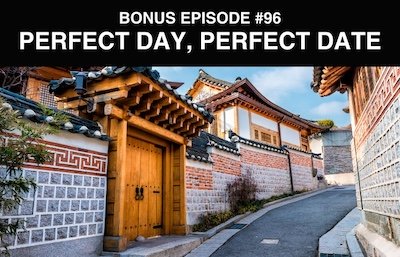
You could see the buds and the blooms slightly coming out on some of the trees and flowers as well. So spring was in the air. It was awesome. And for this date day, we decided to check out a neighborhood that is close to some of the royal palaces in downtown Seoul. For Korean people who are familiar with Seoul, the neighborhood is called Wonseodong.
And yeah, we decided to check out that neighborhood, explore, and just see what it was all about for our date. It’s a neighborhood that I’ve wanted to visit for a long time, but haven’t had a chance to yet. So, I suggested going there to my wife. She has been there before, but she said, “Yeah, that sounds like a great idea. Let’s do it.” And so, we did it.
So, we went there. And one of the things that I love about living in Seoul is that history is really everywhere. If you open your eyes and if you pay attention, you can find interesting historical things everywhere in the city. And of course, this is true probably for all places in the world. Humans have lived in all corners of the world for thousands and thousands of years.
So, there’s history everywhere. But there are traces of history in higher concentrations in some areas of the world versus other areas of the world. If you live in a place like Asia or Europe, probably it’s very easy to interact and experience history every day.
However, where I’m from in Western Canada, of course, there have been people living in that area for thousands and thousands and thousands of years, but not too many people. There weren’t like mega civilizations in that part of the world. And there aren’t as many traces of those original people’s histories as I would like.
Of course, in Canada, there are historical monuments, there are historical sites, and you can experience history by visiting these places, but not to the same concentration as we have in Korea, or as we have in Seoul. So, this is one thing that I’ve been trying to tune into more and trying to pay more attention to is when I’m out just walking about in my daily life is to keep my eyes and ears open to try and find more about Korea’s history.
And really, it’s pretty easy to do. If you tune into it, you will notice things that maybe you’ve just walked by 100 times and never really noticed. But then once you’re paying attention, you go, “Ah, wow, that was there. I never saw it before. Like, how did I miss this?” And you can learn about some interesting history.
So, my wife and I, we had this experience while we were walking to Wonseodong, the neighborhood that we checked out, we noticed that right in front of an office building that we had walked by maybe 500 times before, like this is an area of Seoul that we visit quite frequently.
So, we’ve been there many, many times, we noticed that in this modern office building, in the parking lot of this office building, that there’s a meteorology and astronomical observatory and office, and the remains of some of this facility. Of course, it’s not fully intact anymore, but there are some traces of it and some things that you can see that dates back to, and I wrote the date down here, 1434.
So that’s incredible. That’s 590 years ago. That blows my mind. Like, it’s very, very rare that you could see that kind of thing walking around in Western Canada, in Kelowna, my hometown. So really, really incredible. I have a picture of me standing in front of the remains of that facility. And I’ll put that on our Instagram and Discord so you guys can see what I’m talking about.
I just love that. I think that’s a really cool thing to experience here while I’m living in Korea. And I’m going to try and keep my eyes open for more history, because it’s really everywhere. And there are interesting stories that you can hear. And I have some other experiences that I’ve had running into history recently. And maybe I can share them with you in upcoming Culips episodes.
But for now, I’ll move on to the next keyword that I wrote down here, which is “Walking slowly and looking at old houses.” I guess that’s not a keyword. That’s a key phrase.
But I wrote that in my notes, because that’s the next thing that my wife and I did on our date is we walked around this neighborhood, which, as I said, is right beside one of the palaces in Seoul, not the main royal palace, but one of the smaller palaces.
And so, you got to imagine that this has always been a pretty nice neighborhood, and probably a pretty wealthy neighborhood being right beside one of the palaces is this, you know, nice area, nice neighborhood. So, it’s still a nice neighborhood. And it’s old and historical, as I mentioned, but there are a lot of great houses in this neighborhood.
And little old houses, Korean traditional style houses called hanok and some more modern houses as well. So, I think ever since my wife and I bought our old house, and we restored it and renovated it, we’ve become not super obsessed with architecture, but more interested in architecture, and especially the little details that builders and homeowners have put into their houses.
So, this is one of the things that we love to do is just walk around neighborhoods, and again, keep our eyes open for little details.
And so, I love just looking at the houses and seeing some of the unique features of each one, and especially looking at the little decorative elements like the roof tiles, or the front gates, or some of the decorations and designs that are on the handles to the front gates, some of the ways that the houses have been painted, especially older houses.
Some of the tile work that you can see either in front of the house or inside the house. I think this is so cool. So that was one of the ways that my wife and I spent our date day was just strolling through the neighborhood, having a nice conversation as we walked around, we took a lot of pictures, and I’ll share some of the pictures with you from that experience.
And just looking at the houses and talking about them and kind of plotting and planning for the future. Like now after we have restored and renovated one house, we always talk about, “OK, will we ever do this again, maybe sometime like well into the future?”
I don’t plan on moving or doing anything like this again, anytime soon, but who knows 10 years down the line, 15 years down the line, if we ever have another opportunity, what kind of things would we like to do? It’s fun just to, you know, chat about that and to share our thoughts with each other. So, we did that as we were walking around the neighborhood.
So, the final keyword here that I have on my notepad is Jangsu. Jangsu is a Korean word, I’ll explain in a moment all about why I wrote this down in my notepad. So, after my wife and I explored the neighborhood, we enjoyed the spring, we took some photos, then it was time for lunch. And we just went to a local restaurant in the neighborhood that served a kind of pork that is boiled and served with kimchi.
And this is one of my favorite Korean lunches. It’s a delicious meal. And it was in this kind of traditional restaurant where we sat on the floor. And I’ve talked about this before, in past Culips episodes, how traditionally in Korean restaurants, often you would sit on the floor. However, this floor sitting culture has not totally disappeared, but I would say to a great extent has disappeared.
And now, at least in my opinion, it’s harder and harder and harder to find restaurants where you sit on the floor. But in this restaurant, we actually sat on the floor. So that’s always a little bit hard on my ankles. My hips are OK, my legs are OK.
But my ankles seem to get a little bit sore after 40 minutes, I guess probably that is when I start to shake my ankles a little bit and try and loosen them up. But yeah, we sat on the floor, we had this wonderful, boiled pork and kimchi meal. And it was great. The food was like 10 out of 10 delicious.
And as we were eating, my wife suggested, how about we have some rice wine, rice wine, makgeolli, as it’s called in Korean pairs really well with this dish. And so, I was like, “Yeah, let’s do it!” Over the last little while, I’ve been not really hardcore dieting, but slightly dieting, getting ready for the marathon that I had to run.
And so, I really was careful about many of the things that I was eating and drinking. And one of those things was alcohol for a long time before the marathon, I was really not drinking very much alcohol at all, pretty much zero. So now that the marathon is done, I’m like, OK, yeah, let’s relax. We’re having this nice, leisurely Sunday afternoon date.
Let’s share a bottle of rice wine together. So, we ordered the classic rice wine here that you can get in Seoul, which is called Jangsu. So, we had a bottle of Jangsu together. And it’s pretty good makgeolli. It’s not the best I’ve ever had, but it does the trick. And it’s also very affordable. You can buy a bottle of Jangsu for like $1 American like it’s very, very cheap.
There’s a little markup when you buy it at a restaurant. But if you buy it in a store, it’s around $1 American, which is incredibly cheap. And the reason why I’m telling you this story and the reason why this is a little bit funny is that in the next couple of weeks, I think in early April or mid-April, I have to check my calendar and find out exactly when, but I am going to be participating in a trail running event.
And I’ve never done anything like this really before. I’ve participated in many different running races, but I haven’t done a race that is totally a trail race before. Now, I’m not really planning on running this race fast. It’s more like just something that I’m going to enjoy. I’m almost thinking of it as being more like a hike, like a jog in the forest. I’m doing it with a couple of my friends.
And the race is taking place in a small little city in southern Korea. Actually, I don’t even think it’s a city. It’s like a village. And the village name is Jangsu. It has the same name as the makgeolli brand, as the rice wine brand. Now, Jangsu, the rice wine, actually means long life. So, I think that’s kind of a nice name for a rice wine. Like, you think, “Hey, if I drink this, I’ll live a long time.”
Now, I don’t know, actually, if that is the case. I doubt it, in reality. Usually, alcohol is bad for your health, not good for your health. But it’s a nice thought to think about, right? And I don’t know exactly the origin of the name of the village, Jangsu. I’m imagining that it has a different meaning. But I’d have to consult somebody who knows more about that than me.
But they both have the same sound. And yeah, I’ll be visiting Jangsu in just a couple of weeks to do this trail running event. And so, as I mentioned, I’m doing it with a couple of friends. And we have a little group chat going. So, as we were there in the restaurant, I took a photo of me holding the bottle of Jangsu. And I sent it to my friends.
And I said, “Hey, guys, I’m preparing for the Jangsu race. I’m doing some hard training right now.” And I thought that was a kind of funny moment. And really, a good example of my best dad joke on display. And they kind of rolled their eyes and said, “Oh my god,” in the group chat in response to that. But it made me chuckle.
And if your humor makes you chuckle, well, I think that’s good enough, right? So anyways, we finished up our lunch there. We shook out our ankles and got our legs back into perfect condition. And then we decided to go for a coffee. We walked around the neighborhood. And there are several different coffee shops in that neighborhood where we were visiting.
But they were all full. It’s incredible. Seoul has thousands and thousands and thousands of cafes and coffee shops. They’re everywhere. Literally within, like, I’m not even exaggerating, probably 100-meter radius of my home where I’m sitting right now. There are probably six different coffee shops, six different cafes within 100-meter walk. And this is like, not rare for Seoul.
They’re everywhere. However, on Sunday afternoons, on a nice day when many people are out and about, it is really, really hard to find a cafe that you can visit that has empty seating. So, we walked around to this cafe and that cafe and this cafe and that cafe. And we couldn’t find anywhere with any empty seating. So finally, we gave up.
We just went home, and we enjoyed a coffee in our yard. Which was fine. Saved us a little bit of money. And yeah, it was a nice way to wrap up the day. So, everyone, that’ll bring us to the end of this one. Another bonus episode is in the books. If something is “in the books” it means it’s finished. It’s written in the history books. I think that is like the origin of that expression.
It’s in the books means it’s written in history. So, bonus episode 96 is in the books. It’s written in history. And if you made it all the way to the end of this episode, then let’s use that phrase as the completion phrase.
So, if you leave a comment on our Instagram or YouTube or discord with that phrase, “it’s in the books”, then I will know that you made it all the way to the end and other members of our community will know that you made it all the way to the end of this episode. And it’s been really fun for me to read all of your comments where you guys use this completion phrase.
And some of you have been making sentences where you insert the keyword or key phrase into a sentence. And that’s really cool. So maybe you can be creative with this phrase, “it’s in the books” And you can make a sentence or tell a little story and insert that into the sentence or into the story.
And that could be a really fun way to practice your English, to be creative, and to share that you’ve completed this episode with our community. So, everyone going forward into this next week here have an awesome one. Keep up your English study. Remember that being active with your English and consistent with your English is one of the best ways to grow.
And you will notice growth if you do these two things: if you are active and if you are consistent. Alright, that’s it for me for this one. Take care and I’ll talk to you again in the next brand-new Culips episode which will be coming out very very soon. Goodbye!
