

Hello everybody, how's it going? My name is Andrew, and you are listening to bonus episode number 88 of the Culips English Podcast. I hope you're doing well, and it's great to be back here with you for another exciting week of English learning.
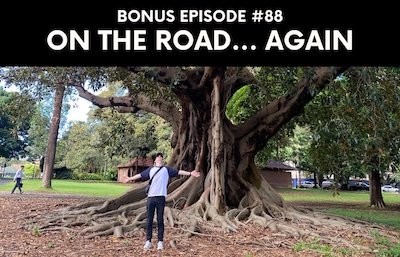
And today, we have a very special episode for you. Well, at least for me, it's a special episode because I am recording from a place where I've never recorded before. I am on the road.
I am away from Korea for a few weeks, and I'm wondering, can you guess where I am? Can you guess where I am? I wonder if where you're from, you have this series in your country.
It's called "Where in the World is Carmen Sandiego?" I used to watch this TV series when I was a little kid. It was on PBS—PBS, Public Broadcasting Service. I believe the "S" stands for…
I'm not exactly sure what the "S" is all about, but I think it's "service," PBS. And this was, or is, because it's still around, an American TV channel, a kind of public broadcaster.
They play a lot of documentaries and educational programming and that kind of thing. And when I was a kid, there was a game show on PBS called "Where in the World is Carmen Sandiego?"
And this game show was kind of a trivia show, you had to answer questions about geography and you had to be a kind of detective and track down the location and whereabouts of this mysterious person who, I believe, was a criminal like she committed some kind of crime, and you had to find her—find where in the world she was.
And her character's name was Carmen Sandiego. And then I remember playing this as a video game as well. I think even when I was an elementary school student, we had it installed on the computers in my school's computer lab.
So, I remember playing "Where in the World is Carmen Sandiego?" instead of doing the typing practice that I was supposed to study when I was an elementary school student as well.
So, whether you're familiar with this series or not, I want you just to think about "where in the world is Andrew?" And I'll tell you the answer here in a second, but I'll let you chew on that. Think about it.
And who knows, maybe you'll be able to guess where I am. But before we get into that, I should explain what the bonus episode series is all about.
So once a week, at the start of the week, I upload a 20 or 30, or sometimes 40, if I'm too talkative, minute episode, where I tell you some stories from my everyday life as a Canadian living abroad in South Korea.
And the goal is that by listening to this series, you'll be able to build your English fluency and increase your knowledge of the culture of English-speaking people, and grow your vocabulary, and ultimately become a better communicator.
And for each episode, I create an absolutely free interactive transcript and vocabulary glossary. And you can follow along with them and use them as you listen to this episode.
They're amazing study tools, in my opinion, of course, I'm biased, but I really do believe that they're very helpful for building your English skills. And you can get the glossary and the transcript just by following the link that's in the description for this episode.
And if you're a Culips member, then I also create a 10-question multiple-choice comprehension quiz that I will post the link to in the member-only area of our Discord community.
And of course, we have an amazing Discord community, it's open to everyone. We do have our special member-only section, but that doesn't mean that there aren't places where non-members can participate.
We have many, many channels where everyone is welcome. And it's a great place to connect with other Culips listeners from around the world, practice your English output.
You can make posts, you can comment, you can chat with other members. You can even have audio and video calls as well. So, it's a really awesome place to practice your English speaking and writing.
And to join our Discord, if you're not a part of our community yet, then you can just follow the link that's in the description for this episode. And I think, with that being said, those are all the announcements that I wanted to run by you before we get into this week's main part of the episode.
And for this week's episode, guys, I'm just going to talk here for a few moments about where I am and what I'm doing abroad right now. So, as I mentioned at the start of the show, I am out of the country.
I'm not in Korea right now, and I'm also not in Canada. As you guys know, I'm from Canada originally, but I'm not visiting home right now. I'm in a different country.
And yeah, I'm wondering, what did you guess? Where do you think I am? Probably your first guess would be somewhere close to Korea because it's more likely that I would go on a short trip to a country nearby Korea, like maybe Vietnam or Cambodia, or Thailand, or someplace like that, right?
But no, I'm not in Asia anymore. I've traveled to Australia. I'm in Australia right now, and my wife and I are here together. And we're going to be spending the next few weeks in Australia.
So, I'm going to tell you all about what we're planning to do and some of my initial reactions to what life in Australia is like. I haven't been here for too long, but so far, so good. I really, really like this place.
So that's what I'm planning to tell you about in this episode. And guys, you'll have to excuse the audio quality. If it doesn't sound up to snuff, if it doesn't sound as good as it usually does, well, that's because I'm doing my best to record here while I'm on the road. But I don't have access to my pro Culips studio that's back home.
So, I think this is good enough, I think you'll be able to hear me clearly. And you should still have no problems listening to this episode. But please, just keep in mind that if it's not exactly perfect, well, I'm trying my best.
And one thing that I realized that I should have brought, that I didn't bring, was a mic stand. Because right now, I am holding my mic in my hand. But the cable that I'm using for the microphone is extremely sensitive.
So, if I move my hand just a little bit, then you hear that noise of the movement. So, I'm trying to hold the mic in my hand and be incredibly still and not motion or gesture too much while I'm speaking, which is hard for me, because I'm usually an animated speaker.
I'm usually someone who likes to move their arms a lot and move my hands a lot when I speak. So, I'm trying to be very still right now. And I'll do my best. OK, but if this episode is a little bit short today, then that's probably because my hand is tired.
So, I don't know, maybe I'll go to an audio store or a music store and buy a mic stand for next week because I think that might be a worthwhile investment. I don't know, maybe this will build some muscle, though, in my arm. I don't know, we'll see. We'll see how it goes.
So just keep in mind that I am on the road. I'm not in the Culips studio back home, and the audio quality will be a little bit different.
So anyways, let me start at the start. And my wife and I are lucky enough to have a little bit of flexibility in our schedule, where we could get away for a little bit at the start of the new year, towards late January and into February.
And last year, we also had some opening at this time of the year. And during that time, we visited Canada. And if you recall, if you've been a longtime Culips listener, you'll recall me talking about that trip.
If you are a new Culips listener and you didn't hear about my trip to Canada, then I'll go back and I'll try and find the link and link you to some content in the description for this episode.
So, you can go back and hear that. But yeah, after the pandemic, after COVID, when travel restrictions were finally lifted, and we could travel again, last year for the first time, the first place that we visited was Canada.
Just because, really, during the whole COVID pandemic and shutdown and travel restrictions, you guys know what I'm talking about. We all went through it, everyone around the world.
Well, during that time, we couldn't really travel at all. But that was also the time where my wife and I got married. And so, because of all of the travel restrictions, my parents couldn't come to Korea, they couldn't go to the wedding.
My wife wasn't actually able to meet my side of the family until after we got married. So, when we traveled last year to Canada, that was like a very important trip. Not so much like a vacation, but just something that we had to do.
Like my wife had to meet my side of the family, had to meet my relatives, had to see where I come from. We thought that was a very important thing to catch her up on. Of course, my wife is Korean, for those of you who don't know, and I am Canadian.
So as soon as we had a chance to travel, we did go to Canada. And yeah, Canada is great. Of course, I'm biased. It's my home country, but I love spending time there. However, Canada really shines in the summer, especially my hometown and my region of Canada. I come from the west coast of Canada, the province of British Columbia.
And during the winter in my hometown, Kelowna, it's usually cold, not crazy, crazy cold, although this winter, it has been pretty cold some days, but usually it's just like, I don't know, minus five, minus six degrees Celsius in the winter, not too cold, but it's very gray all the time in Kelowna, and the winter is not the most pleasant time.
In the summer, though, the weather is amazing, it can get quite hot, sometimes getting into the upper 30 degrees Celsius. It's very dry, there's no humidity, and it's really sunny in the summer.
There's a big lake in the middle of the city, nice beaches, and just a good vibe in the summer. So definitely, in the future, when we have the option to visit Canada, I want to go in the summer.
So, when we had a chance to travel this year in the winter, my wife was like, "Shouldn't we go to Canada? Shouldn't we see your family? Don't you miss your friends?" etc., etc.
And the answer to all of those things is yes, yes, yes. But I didn't want to get into the habit of visiting Canada every time in the winter. Going every winter. It's just a terrible time to visit.
Not so pleasant, not a whole lot of things you can do. The only real benefit about visiting Canada in the winter, in my opinion, is that doing the touristy things is much, much cheaper because it's the low season.
Except if you want to go skiing, then it's very expensive. But all of the other touristy things, and you know, hotel prices, restaurant prices, all of those things are much cheaper in the winter.
So that is one of the upsides about traveling to Canada in the winter. But I didn't want to get into that cycle of going each winter. So, I said to my wife, "Well, you know, if we can go in the summer, that would be much better.
You would have a better time. I want to really show you the best side of Canada, and visiting in the summer is better." So, we're not quite sure yet if my wife will be able to visit Canada in the summer this year as well.
I mean, it's pretty amazing if we can pull off two international trips in one year, but at least I can sneak back and see my family for a little bit in the summer.
And then, if maybe she goes like every other year or something, that would be OK. But anyways, so we decided, "OK, in the winter, we're going to skip Canada. And we should go to someplace where it's warm and nice."
And so, we were thinking about places where we wanted to go. And my wife and I both love traveling, I would say we're like semi well-traveled. I've been to many countries, but there are still so many places I haven't been before.
I've been to many places throughout Asia, I've been to a lot of places in Europe, not everywhere. And I've been, of course, to North America. But there are still so many places I haven't visited.
So, I think I'm like semi well-traveled, you know, I've traveled a lot. But I'm not one of those real globetrotters who have been to every continent and many, many, many, many, many countries.
I think you could probably count the countries that I've been to on two or three hands, maybe. So anyways, we went back and forth with different suggestions: "How about going here? How about going there?
How about going here?" And the place that we both agreed on and finally settled on was Australia. So here we are. Now, for a long time in my life, I actually didn't want to visit countries where English was the main language that was spoken.
That's just because I felt like traveling to the United States, or traveling to England, or traveling to Australia just wasn't enough of a travel experience for me.
One of the reasons why I love traveling is you get to experience a totally new culture, you get to experience people who think differently than you do, who look differently than you do, who act differently than you do.
You get to experience new smells, and tastes, and sights, and all of these things. But I felt if I went to another English-speaking country, then I got that to an extent, but I didn't get that to the full amount that is possible.
So, for all of my 20s and up until, yeah, into my 30s, I was always really against going to other English-speaking countries. Now, I don't know if it's because I've got more travel experience in now, or if it's just because I'm older, I'm not sure.
But my mindset has changed on this. All of a sudden, I'm way more open-minded to traveling to other English-speaking countries. And just before the pandemic, I traveled to the UK. I visited England, I visited Scotland. It was amazing.
And I really enjoyed my time there. And I realized, "Huh, you know, traveling to other English-speaking countries as an English teacher is also probably a good idea!"
It's good research for me, it helps me to become a better English speaker, to interact with different kinds of English speakers from around the world, and to learn about the little nuances and differences in the way that English speakers communicate from country to country to country.
So, although I was really against that in the past, now I embrace traveling to other English-speaking countries. And I do have to say it's much, much easier.
Right now, if we were visiting a country where English wasn't spoken and wasn't the main language, I would have had to put a lot more effort into just doing everything, right?
It's a lot of work when you can't speak the language of the country that you're visiting. And I do have to say, I think this is a real blessing. And I'm very lucky to be an English speaker in this regard, because there are many countries around the world where English is the official language, but also because, just as an English speaker, you know, it's the world's language, right?
It's the global language. So even if I were to visit a country where English is not the main language, I could probably use English to communicate, at least at restaurants and hotels and that kind of thing.
So anyways, yeah, my wife and I agreed, Australia. So here we are, we're going to be spending about a week in Sydney. And then we're going to Melbourne, and we'll be spending a little bit of time in Melbourne.
And then on the way home, we'll be briefly stopping in Singapore, and we have a kind of a long layover in Singapore, I think we're going to stay there for two nights or something. And then we're back to Seoul.
So, I'm really, really excited about this trip. And now we've been in Sydney here for a few days, we're staying in the downtown area of Sydney. And it's awesome, guys. I'm just really loving it.
And I have to say, the first impression that Australia has given me has been very, very good. I'm having a great time. I really like this country so far.
And I think a little bit later, I'll probably record a whole separate episode about some of the things that I've noticed about Australia that make it different from Canada or different than Korea, some of the unique things that I've noticed about Australia.
I'm going to save that for a different time and a different episode. But just to give you like a brief peek into what I'll talk about there, the first thing that I've noticed is that the weather is amazing.
Here in Australia, it's in the southern hemisphere. So, we are in the summer. So, it's just beautiful, beautiful weather, not too hot. I was worried that Australia would be extremely hot, but it's just perfect, in like the high 20 degrees Celsius, and nice blue skies. Quite windy.
Everywhere we've been has been quite windy, but still very, very beautiful. And the sun, importantly, the sun is not too strong. Because I'm a burner. I have very weak skin.
If I'm out in the sun for too long, I tend to burn. So, although I have been putting on a lot of sunscreen and wearing my hat, thankfully, I haven't been burned at all. I do have to say that I'm very jealous of my wife, she's a tanner, so she can just go out in the sun and get a nice, lovely tan.
But I'm not like that. And honestly, I feel like I'm one of the whitest people in Australia. A lot of the Australians that I've seen also have these wonderful golden tans, and yeah, they're sun-kissed, and I wish I could get a nice tan like that. Who knows, maybe after I've been here for a while, I'll also have a nice Australian tan.
But for right now, I'm kind of the pale guy in the shade. But thankfully, the sun isn't too hot. And that's good for me. So, we've been enjoying the weather. I also have to say the vibe is really great here.
It seems really chill, kind of a slower pace of life. Definitely compared to Korea and Seoul, where it's just go, go, go all the time. Here, it seems to be rather quiet and relaxed. And I don't know, it's a very nice change of pace, something that I wasn't really expecting.
But something that has been very welcome. It's nice just to slow down and take a moment sometimes. And I'm able to do that here. The other thing that both my wife and I noticed right away is that Australia is expensive.
I knew that Australia was going to be more expensive than Korea, and probably more expensive than Canada, but I wasn't quite expecting it to be as expensive as it is.
So that was a little bit of a shock. "Sticker shock" is what we call that, you know, like when you're shopping, and you pick up something off the shelf and you look at it to see how much it costs and you see the price tag or the price sticker.
And you're shocked, and your eyes open wide, and your mouth drops open. That's what we call sticker shock. So, the sticker shock is real here. Especially going to restaurants and going to the grocery stores.
Things seem to be really, really expensive. So, my wife and I have been mindful of that, and we've been trying not to eat out as much because I think it would be really, really expensive to eat out every meal in Australia.
Something that you can do in Korea, actually, is eat out almost for every meal if you wanted to. It's affordable to eat out in Korea, but here in restaurants in Australia, not so much. It's kind of more like back in Canada, where going to a restaurant is, you know, something that you can do to treat yourself every once in a while. But it's a luxury, it's not something that you can do for every meal.
So, because of that, my wife and I have been hitting up the grocery stores, we've been buying some fruit, lots of great fruit, really fresh and delicious fruit at the grocery store.
And there's a local market just down the road as well, that's open a few days of the week that we've been going to. And so yeah, enjoying some of the fresh fruits and produce, and I've been making sandwiches, and we bought a picnic mat.
And we've been going to this park that's near where we're staying, and just having picnics for lunch. And so that's been really delicious, really great, and a way that we could save some money as well.
Another thing I've noticed that's been really, really awesome about Australia so far is all of the plants, trees, and animals that we've seen. We haven't really been out to see any of the famous Australian animals yet.
The kangaroos and the koalas, and, you know, all of the famous Australian animals. We are planning to do that a little bit later. But we haven't done that yet.
But despite that fact, it doesn't really matter because you can just go to the park. And you can see these beautiful huge palm trees and just really, really interesting pine trees and all sorts of amazing plants.
Like, one of my wife's hobbies is gardening, and I enjoy gardening as well. She's more of an aficionado than I am, but I still enjoy it as well. And you can see, just out in the wild, growing in the park, the same kind of houseplants that we have in our house.
Like, these tropical host plants that we keep at home, and we have to baby and care for so much in our home, are just growing out in the wild here in the park and in people's yards. And they're huge.
They're much, much bigger than anything that we've seen in our lives before. So, we're just in awe and shocked and marveled at the amazing plants and flowers—very, very beautiful. And the wildlife as well.
The birds are so unique. And you can just see parrots flying around in the trees, and they're squawking away. And you can see cockatoos, the white parrot with the kind of yellow feathers on its head.
I'm not really sure what those are called, it looks almost like a crown, you know. They're just flying around squawking away as well. So, that is just awesome to see.
I think, for many of our listeners, especially you guys who come from warm countries or come from places around the equator, this is nothing new for you. But I'm from Canada, and my wife is from Korea. And we don't get to see this kind of flora and fauna very often.
So, that is really, really cool to see. And actually, spoiler alert, I know I've been giving a lot of spoilers away on the show recently. But I'm working on trying to get an Australian animal expert to appear on Culips as a special guest and to have an interview with that expert about the plants and animals that are native here to Australia.
And I think that is almost confirmed. So, we should have a really interesting interview coming up for you here on Culips sometime in the near future to talk about the wildlife of Australia.
So, I'm really looking forward to that. And I hope it actually comes to fruition so that I can share more with you. And I can also share with you the opinion of an expert because I don't really know too, too much about Australian animals.
But I hope that I can learn more while I'm here and through that conversation with the Australian animal expert. So, stay tuned for that.
So, everyone, as I predicted at the top of the show, my hand is starting to get a little bit sore. And I'm starting to become a little bit uncomfortable from maintaining the same position without moving at all for the last little while.
So, I think I'm going to wrap things up here for now. But yeah, I just wanted to give you an update about where I am and what I've been up to. And I'm really looking forward to the week ahead here in Australia.
My wife and I have some things that we want to do, we're going to go on a tour to see some wildlife. We're also going to go to the beach and do some swimming.
My wife has been taking swimming lessons for the last six or seven months or so. So, she's really excited to try out swimming in the ocean here, even though the ocean can be dangerous.
But I read that there are also many pools at the beach, so I think we'll stick to swimming in the pools. Probably not swim in the ocean too much because that honestly scares me a little bit.
You know, the waves and the currents and the sharks and the rays and the jellyfish. I don't know if I want to really risk it all in the Australian ocean.
So, I think we'll stick to the pools for swimming and the beach just for hanging out on, but we have plans to hit up the beach. And also, I am really, really excited to do some running here in Australia as well.
To be honest, that is one of my favorite things to do in a new country, is just to go for a run and get lost a little bit and explore. You can see different neighborhoods and different things that are off the beaten track, the things that you don't find in tour guidebooks, you know?
So, I brought my running shoes with me. And I'm planning to get out there and hopefully run a lot of kilometers and just check out and see what this country has to offer.
And I know we do also have some listeners, some Culips listeners, in Australia. So, I don't know, if you're a Culips listener and you are in either Sydney or Melbourne, and perhaps maybe you'd like to meet up while I'm here.
Well, you could send me a DM on our Discord server or send me an email to Andrew@Culips.com. And who knows, if our schedules line up and it's possible to meet up, that could be cool to do. I would definitely be open to meeting any Culips listeners while I'm here.
So, guys, send me a message if you would like to try and make that happen. And who knows, if we get maybe several people who are interested, maybe we could do a Culips group meetup as well.
We'll see if that is possible. But for now, I think I'm going to sign off because my hand is starting to fall asleep and go numb. So, if you made it this far to the end of the episode, everyone, thank you so much for studying English with me today.
I think you did a great job. You started off the week on the right foot with an English study session. So, be proud of that, but keep it going.
I hope that you'll have a very productive and fruitful week of English studying up ahead. And of course, we'll be back here at Culips with another brand-new episode coming out in a few days. So, until then, take care, and I'll talk to you next time. Bye-bye!
