

We come back again and again, week after week, and so you are here, and I am here and we’re doing it together. We’re improving our English fluency together. So welcome and it’s great to be here with you today.
If you’re new to our bonus episode series, let me quickly explain what it’s all about. I just share with you some stories from my everyday life as a Canadian living abroad in South Korea and I hope that by listening to these stories you can learn English and improve your fluency in a fun and entertaining way.
You’ll be able to build your English vocabulary, and grow your fluency, and improve the understanding level that you have of the culture of English-speaking people, to improve that as well. So, all good things, right? Leveling up on all of our skills.
And of course, we also have a Discord community that you can join for free and on our Discord community you can connect with other Culips listeners, and you can practice your English speaking as well. So, we really have all of the grounds covered here for you at Culips to help you improve your English.
So today, what I am going to do is just tell you a couple of very short stories because I am recording this on Saturday afternoon, and I have to go meet my wife soon for a date. We’re having a Saturday night date night, so I only have about 30 minutes to record this episode, so I’m gonna try and squeeze a quick one in and hopefully everything goes smoothly.
So, the two stories that I wanted to tell you today, well I guess before I jump in and share them with you, I do want to remind you that there is a free interactive transcript and glossary that you can get to accompany this episode.
So, just visit the link that we will put in the description for this episode, follow that link, tap on it if you’re on mobile, click on it if you’re on your computer and then you can follow along with the interactive transcript, which is awesome. Just click or tap on any word and you can hear the audio repeated from that point.
And then in the vocabulary glossary, I’ll choose maybe 10 or 15 of the difficult words or expressions and I’ll give you a simple definition just to help you improve your understanding of everything that you’ll hear in this episode. So, check that out for free.
And also, if you are a Culips member then just as a way to say thank you to our paid-member community, I’m gonna give you guys a quiz as well and I’ll post that in the member-only channel of our Discord server. So, with that being said I think we’re ready to get started with this episode.
And I don’t know if you can hear it in my voice guys, I’m not sure if it’s coming through loud and clear or not, but I’m a little bit tired today. But tired in a good way because maybe if you remember from several, well, now several months ago, back in I guess it was October maybe October if I recall correctly, I ran a marathon with my running buddy, Jimmy.
He’s an American guy but he lives here in South Korea, just like I do. And we made a goal for this year for 2024, we’re gonna run some races together, but we also made the goal to do a long-distance challenge together we’re gonna run a long distance together. And the longest I’ve ever ran in my entire life is 50 kilometers.
Back when I was dating my, well, now she’s my wife but back then she was my girlfriend so when we were dating, I kind of stupidly decided I’m gonna run from my house to her house. And we lived about 50 kilometers apart. So, I did that run one day and I kind of got into trouble on that run.
It was a lot more difficult than I was expecting and I wasn’t prepared for it and so halfway through that run I kind of bonked. And that is the expression that we use sometimes we also say, “hitting a wall.” This kind of running slang and I think bikers, cyclists use this word “bonk” as well. It just means like you run out of energy, right?
You’re running along, everything’s OK and then suddenly you have no energy. So, when I ran to my, well, then girlfriend’s place at the time it was difficult because I bonked about halfway through and I was really dragging my feet and just trying to make it to her house, which I did in the end.
But as I said, I got into trouble because we were supposed to have a date day that day as well, but once I arrived at her place I was just totally zonked. “Zonked” and “bonked.” Two kind of funny words, right? “Zonked” means to be completely tired, totally tired.
So, actually they have a very similar meaning. “To bonk” means to just run out of energy and then if you’re “zonked” you’re completely tired. I love those words. The colorful English language, right?
So, I was completely zonked when I arrived at her house and I fell asleep and I think I didn’t wake up until the next morning and I missed our date night, so she wasn’t very happy about that. But that was a long time ago and that was the- the longest run that I’ve ever done.
So, when I was talking to Jimmy when we were trying to find some challenges for us to do in 2024 and I think Jimmy and I and I- I’m gonna get him onto Culips sometime soon so we can talk about this I was talking about this with him the other day and he’s down to do an interview, so I’ll get him onto the podcast sometime so you can hear about this.
But yeah, we were chatting about what kind of challenge do we want to do, and I don’t know if it was his idea or my idea, but one of us suggested, “Hey let’s run a 50-kilometer run.” And when I say run, it’s more like slow jogging. Taking it easy, right? Not to run for speed but just to run for distance and to try and do that 50-kilometer mark.
So, we both said, “Yeah that sounds like a fun challenge.” You know, we did a marathon back in the fall and so 50 kilometers that’s only another 8 kilometers after the 50, so we decided to do that, and we were trying to find a time that worked for both of our schedules, and we found a good time and that time was last week on Friday.
So, we both had the day off amazingly and we decided to do the challenge. We decided to do the 50-kilometer run. And when planning the run, I used this app called, well, I won’t say the name of the company just to cover my butt. A little bit of a rude expression, but “Cover your butt” just means to protect yourself, OK?
So, to protect myself I won’t say the name of the company, but there’s a popular technology company here in Korea that has a digital-map service, actually a wonderful app and map service that they have. I use it all the time. It’s great. And I used their map app to map out the run, the route, that we were going to take.
And they have this feature in the map app where you can measure a distance digitally so you can see how far it is from point A to point B and you can draw on the map with a pencil and it will tell you the distance. So that was my job since we decided to do this running challenge in Seoul, it was my job to come up with the route.
And you guys have probably heard me talk about this a lot on Culips if you’re a regular listener, but here in Seoul there’s a great network of running paths and biking paths along the streams and the major river that divides Seoul, the Han River, and so the majority of our run was going to take place along the Han River.
And guys these paths are so amazing we were able to complete the challenge, spoiler alert, now I’ll tell you a few more details in a second, but we were able to complete the challenge entirely on these paths and we didn’t have to cross a street or hit a stoplight once we could run continuously the whole time without any stopping for traffic.
So, that’s just a testament, it just goes to show how amazing this network of paths are. So, I had to plan the route and I wanted to make sure that we hit our 50-kilometer goal, but obviously I didn’t want to go too far over, right? Because as you can imagine you sort of want to start at home and finish at home, right?
You want the starting point to be close to your home at zero kilometers and you want the ending point to be close to your home also at 50 kilometers. And then, Jimmy and I we both have the same style of running watch, so you know as soon as our watch hits 50 kilometers and tells us that we’ve reached that goal then boom we could just be home and, you know, we could relax at home and take a shower and clean up and all of those things.
So that was my job to plan the route. And I haven’t cycled too much recently. I’ve been really focused on running and and marathoning, but I do enjoy cycling and I’ve cycled a lot in the past, and I had some routes in mind that I’ve done when cycling. Because although 50 kilometers is quite long when you’re running, it’s not too far on a bike.
So, I’ve done a lot of rides that are around the 50-kilometer mark, so I had a good idea of around the distance and around the area that we needed to cover in order to reach our goal. So yeah, I went on the map app, and I planned out a route, I plotted out a route. We use this verb “To plot” meaning to plan. So, I plotted out our route and it came back in the app.
You know, when you use the drawing tool it came back saying 50 kilometers. So, I was like, “Boom! OK I did it, Jimmy I have the perfect route for us. We’re gonna start close to my home. We’re gonna finish exactly at my home. And as long as the GPS data and the map app is correct, we should be at about exactly 50 kilometers.”
So, Jimmy came up last week on Thursday evening and we decided to leave on Friday morning. Actually, it was a little bit cold on Friday morning, a little bit, I mean it was a beautiful sky, blue sky, nice weather, really sunny. Not a cloud in the sky. Air quality, not perfect.
That’s one of the issues that we have in Seoul sometimes is the air quality can not be so great, but not terrible, could be much worse. So overall, pretty good conditions except it was a little chilly, it was a little cold when we woke up on Friday morning. Jimmy just stayed over at my place.
And because of that we decided, “Oh let’s wait until around 11 or 12 so that the weather can heat up.” Because it was supposed to go above zero to around three or four degrees around noon, so that would be better. We thought if there were you know puddles on the path or any water on the path, we didn’t want it to be ice and frozen water that we’d be running on.
So, we thought let’s wait till it gets above freezing, above zero degrees Celsius, and then we can get out there and we can do our challenge. So, that was cool because we had a nice morning, we drank some coffee, we had some breakfast, we got all of our gear and equipment ready.
Usually, it’s really wonderful if you run this trail network in Seoul, there are facilities every two or three, maybe five kilometers. Like they’re just regularly available on the route. And what I mean by “facilities” are like washrooms and drinking fountains and sometimes even convenience stores.
So, it’s really nice because you don’t have to worry too much about, you know, taking a lot of stuff with you because if you run out of something then you’re never too far away from a washroom, from a drinking fountain, from a convenience store. But in the winter, it’s not exactly that way because all of the drinking fountains are turned off.
So, you know, usually in the spring, summer and fall it’s perfect because when I leave the house to go running, I don’t have to take any water with me. I don’t have to worry about carrying a water bottle or anything like that because when I get thirsty, I know that, oh close to where I am, there will be a drinking fountain and I can just drink some water.
But you know because Seoul, and Korea, is a cold place in the winter, and when water freezes it expands, and it can break pipes and cause a lot of plumbing damage, well all those drinking fountains are turned off in the winter. And also, most of the washrooms along the trail network are also closed, not all of them but most of them.
So, we had to think a little bit more deeply about how we were gonna plan our supplies. And I don’t know when it was, maybe it’s gotta be now like six or seven years ago for one of my birthdays, my parents bought me this running vest. A running vest. And a running vest is like, you know, it’s pretty uncomfortable to carry a backpack with you if you’re running.
I don’t know if you’ve ever tried to do this before, but I have. If you just carry a regular backpack with you on your back when you run, the design of the backpack is not meant for that, and when you start running that bag is gonna swing back and forth and it’s really, really uncomfortable. So, running with a backpack is a no-no, in my opinion.
So, because of this, there are companies that make these things called running vests and they’re designed just to carry your essentials with you when you go for a longer run. Like, there’s a pocket for your smartphone, there’s a pocket for your credit card, there’s some pockets to put these kind of water bottles, I can’t remember what they’re called.
Ah! “Soft flasks.” Soft flask water bottles, I got it. So, there’s some pockets where you can put these soft flask water bottles and on my particular running vest, there’s also a big pocket on the back where you can put a big soft flask. Mine holds two liters of water. So, because we knew that the drinking fountains were closed, we decided to load up.
So, we loaded up our soft flasks with water. I loaded up this big bottle that I can store on my back with two liters of water. And we also brought some running gels so like some- some gels that are very high calorie that you can consume to make sure that you don’t bonk, right?
Because now I know from experience the reason why you bonk is usually, you’re burning more calories than you’re consuming when you’re doing this high-effort activity. And when your body doesn’t have enough energy to continue that’s when you bonk, and you feel exhausted.
So, it’s important to take in calories as you are burning calories so that you can keep going and complete the whole challenge that you want to do or the run that you want to do. So, we packed some running gels and I’m a big fan of taking some like gummy candy when I do a run like this.
So, I took some gummy bears and some gummy worms just as a delicious way, I’m not even a big candy guy but for whatever reason lately I’ve been enjoying this this candy when I’m doing a long run like this, so I took some some gummy worms and some gummy bears as a delicious way to calorie up on the run. So yeah, those were the supplies that we had.
We made sure that we were dressed warmly enough. As I said, you know, we’re running in the winter. It was above freezing, but I think the high that day was still like three or four degrees, so it was a little chilly, so we made sure that we are dressed appropriately.
And then finally right around noon, we hit the road and we were out to try and conquer our challenge, which I think we both felt pretty confident in doing. I think because our mindset was just that we wanted to hit the 50k and just reach that distance goal, then we didn’t feel any pressure about going fast. And I joke with Jimmy, I can go fast, or I can go far, but I can’t do the both of them.
So, if it’s a very short distance I can go you know pretty quickly, but if it’s a longer distance I can get there, but it has to be slow. And Jimmy was totally on board. He’s like, “Yeah let’s just go slow, let’s go long, and let’s enjoy it” and that’s what we did. And really, I have to say that doing the challenge was not that difficult.
It’s so fun just to run with a buddy and you know I do the majority of my running alone, and so to go with a friend and just to be able to chat is wonderful. So, we had great conversations, and I feel like the first 30 kilometers of the challenge, it’s not a race, I keep wanting to say race, but it wasn’t a race, just the first 30 kilometers of the run really just flew by without me even thinking about it at all.
But the challenging part for me whenever I do a longer run is like 30 kilometers, that’s my limit. That’s my body’s limit where after 30 kilometers it’s like, “Nope you should rest now!” It’s done. So, my brain is still like, “Yes you can go, you can do it, it’s no problem.”
But that’s when my ankles start to feel sore, my feet start to feel sore, my legs especially my hips, my butt, oh it’s terrible. Everywhere from the waist down starts to feel sore at around 30 kilometers. But up until that point, I felt great. And it was kind of funny because at that point right around the 30-kilometer mark, was also where I started to feel like the mapping and the plotting that I did earlier when planning our route wasn’t very accurate.
Because like I said, I’ve ridden around the Han River a lot. I’ve biked around the Han River a lot. I’ve run around the Han River a lot. And so, I kind of am familiar with the landmarks and how far away I am from my home at certain landmarks and when we got to about kilometer 30, I was, in my head, I didn’t want to say this to Jimmy right away, but in my head, I thought “Oh no we’re much farther away from my home than 20 kilometers.
I think we’re about 30 kilometers away from my home still, and we’re 30 kilometers into the run!” So, I didn’t want to verbalize that out loud because I didn’t want to demoralize Jimmy at that point. And “To demoralize [someone]” means to bring down their, their morale, right?
And your “morale” is- is your attitude and that feeling of like I can do it, you’re in good spirits, you feel positive, so I didn’t want to break his positivity, his good attitude. Because, you know, when you’re in a difficult physical task, like we were doing this challenge, suddenly if somebody tells you, “Oh you know what at the end we’re gonna have to do an extra 10 kilometers more than you were anticipating, I think that that could be very demoralizing.
So anyways, I kept that in mind because I thought, or I kept that in my mind, I didn’t share that with him, because I thought that maybe I’m wrong maybe it’s not exactly, you know, maybe my you know distancing is off, but that’s when I became aware that ahh maybe I didn’t measure correctly, or ahh maybe that map app didn’t measure correctly our route.
So, then we were continuing, we were running, and we did a big loop, so we did a kind of circle shaped run. You know, we went down one side of the river and came back on the other side of the river. Started on the north, ended on the south, and then came back to the north, that kind of thing.
And one of our first checkpoints, our first stop points, was this convenience store that was around 10 kilometers from my house. So that was like where we did our first pit stop and stopped for some water on the run. And we were planning also to make that convenience store our last pit stop.
And I thought once we hit that convenience store, then I’ll exactly know, on the way home once we hit that convenience store, I’ll know if the measurement of the route was accurate or inaccurate, because I knew for certain that that convenience store was only 10 kilometers away from my house.
And actually, when we were getting closer to that convenience store, you know when Jimmy and I knew that oh it’s you know not that far away another 20 minutes another 15 minutes we’re kind of talking about it and we were both like, “Ah we can’t wait to get to that convenience store to take a little break and it’ll be our final pit stop.”
And we also wanted to get some snacks. We were getting hungry, and I think we had used all of our gels and our water was getting low, so we were really looking forward to getting to that last convenience store again. And we’re counting it down as we’re getting closer and closer, and then finally you can see it on the horizon and you’re getting closer.
And I looked at my watch to see how far we had run, and yeah at that point I realized that we had, or I had, Jimmy had nothing to do with it. Wasn’t his fault, it was my fault. I had incorrectly plotted the route because we were almost exactly around 50 kilometers at that convenience store, and it was still like 10 kilometers away from my home.
So, I was like, “Ah Jimmy I totally messed up.” That’s when I confessed at that point, I was like, “You know what ahh…”. I didn’t, of course, you know the way I framed it, I blamed it on the map app. I was like, “Jimmy that map app is terrible it totally gave us the wrong distance information. Of course, it wasn’t my fault it was the map apps fault, right?”
So, he’s like, “Ah what can you do? We’re gonna hit our goal and then we’ll keep going and if we have to stop if we can’t make it all the way back to your house. If we, you know, we’re just dead and we have to take a taxi or take a bus or jump on the subway, whatever, that’s fine. Let’s just hit our 50k and then keep going.
So, we were like, “Yeah!” And right as we ran into that final checkpoint, we hit 50k. So, we achieved our goal, and we were so stoked. We’re like, “Yeah we did it!” Oh, it felt great, you know, that we had this big challenge to do, and we achieved it and we had a great time doing it.
And then, you know, we were gonna say, “Well it’s actually gonna be closer to 60k today.” We didn’t celebrate for too long because we knew that we still had the final leg of the journey to go. And that’s an interesting word that we use when we’re talking about a stage or a part of a journey or a race, we call it “a leg.”
I don’t know why. Why do we call it a leg? I’m not sure, but that’s what we call it. So, we had the final leg to go from that final checkpoint, that convenience store, all the way back to my home. And as I mentioned, while we were approaching the convenience store, we were really looking forward to it. I think we were both feeling quite sore at that point.
Although I have to say both Jimmy, and I’m gonna pat myself on the back and say me as well. We both did a great job, because we didn’t complain about anything. I know like I said from the waist down I was hurting everywhere but I didn’t say that at all, I didn’t complain, just kept on going.
And Jimmy was the same, but I think both of us were starting to feel a little tender and a little sore at that point. So, we’re really anticipating the convenience store, we got there, we went up to the door, and tried to open the door and it was closed. We looked inside, and it’s like the lights are off, why is the door locked? Why is everything closed?
We looked at our watches. It was about 10 minutes after 5 p.m. and then we saw a sign on the door saying that the convenience store closed at 5 p.m. So, we had missed it by 10 minutes. We’re like, “No!” You know, when I first arrived in Korea, about well way back in the day, I’ve been here you know on and off for over 10 years now.
When I first arrived in Korea back in the day, everything, it seemed like almost everything was open 24 hours, a day seven days a week, 365 days a year, but that’s not really the case anymore. And that famous 24/7 culture that I loved about Korea when I first arrived has slowly disappeared, and it seems to me almost inconceivable that a convenience store of all things would be closed at 5 p.m.
But, you know, I guess it’s not a regular convenience store, it’s only catering to the people who are riding, and exercising, jogging, like we were on the trail. And yeah, in the winter once it gets dark there’s not too many people out there exercising on the trail I suppose. So, rationally it makes sense why they would close at 5 p.m., but at the time it was an emotional blow.
First, we had to deal with my poor route planning and the realization that we are actually going to have to run much farther than 50 kilometers to get home. And then second of all it was that final blow of the convenience store being closed when we are looking forward to getting some treats and refueling there at the convenience store.
So anyways, even though it was closed they had this nice like, tarped off area, with some picnic tables inside so you could, you know, go inside and there’s a zippered door so you could zip up the tarp. It’s like thick plastic, clear so you could see outside, tarp. So, we did that up, we were protected from the wind, we rested for a bit.
We still had a little bit of water left. And actually, I forgot that just when I left the house, I luckily had like this old chocolate bar in the back of my fridge that actually expired in November of last year, so not too long ago. This old, expired chocolate bar that I found in the back of my fridge, and I put it in the back pocket of my running vest.
And I was giving, you know I mentioned that I had that big 2-liter soft flask in my running vest. Jimmy had run out of water, but I still had some water in that soft flask, so as I was taking it out of the running vest to pour some water into Jimmy’s bottles, I noticed “Oh yeah there’s the chocolate bar I totally forgot about it!”
So, I found it in that back pocket of my running vest. And I was like, “Jimmy! Good news, we still have a snack, even though it’s an expired chocolate bar!” But I was like I don’t think it’ll kill us, and so we split it in half, we shared that. And that gave us the fuel, and the motivation, and the boost, that we needed to make it all the way home.
So, we had some water, we had some chocolate, expired chocolate, you know, it’s been over 24 hours since I’ve consumed that chocolate now, and I’m still kicking, I’m still alive. So, I think we’re gonna be OK. And yeah, we did the final push to my house.
And in the end, it was a little bit under 10 kilometers, so I think once we finished our race, and well, our run. I keep wanting to say “race” for some reason, but wasn’t a race, it was a run. When we finally arrived to my home, it was about 57 kilometers that we had traveled in the day. And the whole trip took us just under, just under six hours. Yeah, just under six hours.
So, it was like five hours and 50 something minutes. Five hours, 50 minutes, and change. “And change” is what we say when there’s just, you know, a few minutes and you don’t know the exact number. So, five hours 50 minutes and change I think we got back right around 6 p.m.
So, just an afternoon spent outside here in Seoul, running, enjoying each other’s company, having some great conversation, enjoying the beautiful weather. As I mentioned earlier in the day, the air quality was bad but thankfully as we went along, the air really cleared up.
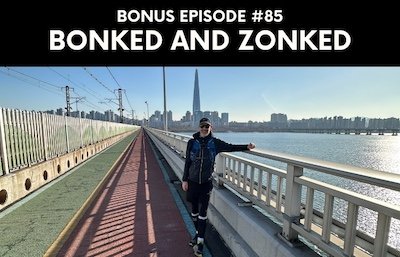
You know, at first, we couldn’t see some of the major landmarks in Seoul, like the Lotte World Tower, this gigantic skyscraper that’s in the middle of Seoul. We couldn’t see that at the start of the day, but by the end it was super clear and visible from very far away.
Some of the mountains surrounding Seoul were hard to see at the start of the day but by the end the air had totally cleaned up and it was just beautiful. So, we saw all the landmarks. We enjoyed the nice weather, the warm temperature, never got too cold, and like I said it was just really kind of a good excuse to hang out and do something productive together as well.
So that’s how I spent Friday last week, and now, well I’m recording this on Saturday. I know you’re listening to this on Monday or going to release it on Monday, but I’m recording this on Saturday, so it’s been a day-ish since I finished and I’m feeling pretty good.
You know, I thought that today I’d be really, really sore and it would be one of those days where I just lie in bed and crawl around and don’t do much of anything. And my wife was anticipating that as well, but I feel great, and I feel so good that I’m gonna go out and meet my wife for our date like I said at the top of the show. Speaking of which, I have to do that really soon.
So, I think I dug myself another hole here, guys. I don’t know if you’ve noticed a trend with these bonus episodes, but I tend to over prepare and I think of a couple of stories that I want to share with you and then once I get going, once I get fired up, and once I get started, then I tend to blab on and on and on and then I noticed that there’s not enough time to share two stories.
Because I know you are busy people, you’ve got lots of things to do in your life as well, and we don’t want to have you listening to me blab on for hours, and hours, and hours. Although if that’s something you’re interested in, then you could always practice some repeated listening and go back and listen to this episode again from the start, if that is something that you are interested in.
But I think this is a good time to wrap things up. So yeah, just to summarize, I feel great. I’m really happy that Jimmy and I were both able to smash our distance PR’s. A “PR” is a personal record. We didn’t just break the personal record, we smashed it.
We did it exceedingly, because as I mentioned my previous distance PR was 50 kilometers and Jimmy’s was the marathon length, 42 kilometers. So yeah, Jimmy’s on a roll, man. He broke his speed PR in the marathon back in the fall and now he smashed his distance PR, so good stuff from Jimmy.
His hard work and dedication to running paid off and I think it will continue to pay off in the future. And I hope that it’ll pay off for me in the future as well. I guess, yeah, that’s a good place to end things for today. So, if you made it this far, thank you for listening and I promise next week the story I’m gonna tell you has absolutely nothing, there’s zero connection, related to running.
So, if you’re worried, like I’m a little worried, that Culips lately has turned into a running podcast, please don’t worry. Next week we have some stories that aren’t related to running at all. And I’ll be excited to hang out again with you next week for another edition of the bonus episode series, so yeah everybody please take care, have a great week of English studying this week, and I will talk to you next time. OK, bye!
